Description
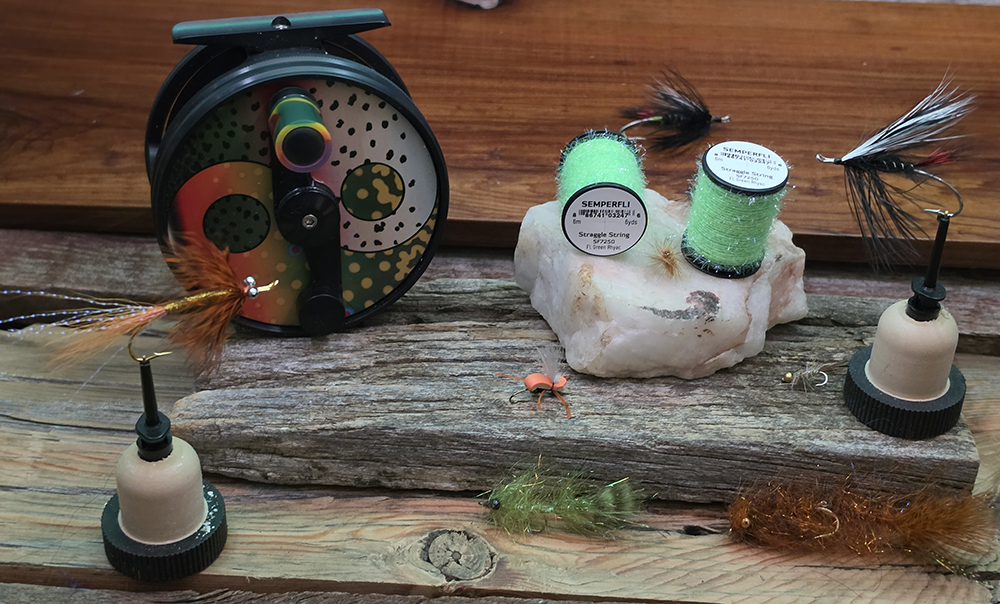
Fl. Green Rhyacophila Semperfli Straggle String Micro Chenille
hyacophila larvae don’t build cases. They crawl free across the rocks in fast water, and they lose their grip and drift every day. That makes them one of the most important nymphs in any riffle from Montana to Patagonia. This color nails their chartreuse-green body. Wrapped in tight turns, Straggle String forms natural segments, and the short fibers suggest the larva’s gills without extra materials.
Recipe 1: Straggle Green Rock Worm
- Hook: Curved grub or Czech nymph hook, size 12 to 16
- Bead: Black or copper tungsten, 2.5 to 3.5 mm, slotted for jig hooks
- Thread: Semperfli Nano Silk, olive or black
- Body: Fl. Green Rhyacophila Straggle String
- Back (optional): Thin Skin, olive
- Rib: Fine copper wire
- Head: Dark brown dubbing, short
Tying: Mount the bead and build a thin underbody well around the bend. Tie in the wire (and Thin Skin, if using) at the rear. Wind Straggle String forward in touching turns to just behind the bead. Pull the back over, rib through it, and dub a small dark head against the bead. Trim the fibers short on top.
How to fish it: Fish it deep in fast, broken riffles where larvae live. A Euro nymphing rig with this as the point fly is ideal; keep tight contact and lead the fly slightly downstream. Under an indicator, set depth so the fly ticks bottom every few seconds. It’s a year-round producer on the Big Hole, the Yellowstone, and Patagonian freestones.
Recipe 2: Straggle Green Weenie
- Hook: 2X-long nymph hook, size 10 to 14
- Bead (optional): Gold or black brass, 3 mm
- Thread: Semperfli Nano Silk, fluorescent green or olive
- Tail and body: Fl. Green Rhyacophila Straggle String
Tying: Tie in the Straggle String at the bend. Form a small loop that extends about a shank length past the bend and lock it down. Wind the same piece forward as the body, tie off behind the eye, and whip finish. One material, under a minute.
How to fish it: The Green Weenie imitates an inchworm, and it’s lethal anywhere trees hang over water. In June and July, drop it unweighted under overhanging branches and let it sink slowly on a dead drift. Weighted, it’s a strong attractor nymph in spring. Bluegill and smallmouth hammer it on a slow twitch.


Reviews
There are no reviews yet.