Bull Bluegill on the Fly, Part Three: Michigan, Wisconsin & Minnesota’s Best Trophy Water
By Capt. Grumpy, Saltwateronthefly.com
Every fishing career has an origin story, and mine happens to be soaked in Upper Midwest lake water from about the age of seven straight through nineteen. Before I ever cast a fly at a permit on a saltwater flat, before I guided a single trout trip in Montana, I was a kid in a canoe or standing thigh-deep off a dock somewhere in Michigan, Wisconsin, or Minnesota, chucking a popper at bull bluegill with a rod that was almost certainly too cheap and a level of confidence that was almost certainly too high. Parts One and Two of this series covered six states’ worth of trophy bluegill water in the heartland — Illinois down through Iowa. This is Part Three, and it’s personal. This is where I actually learned how to do this.
Somewhere around age fourteen, I spent a summer with the Region 7 Explorer Post paddling a canoe roughly 300 miles across Wisconsin — mostly upriver, lake to lake, portage to portage, with a tackle box lashed under a thwart and a fly rod that got more use at camp than the map ever did. A few summers after that, it was the Boundary Waters up in northern Minnesota, where the lakes go from warm and weedy to cold, rocky, and Canadian Shield-serious within a few miles of paddling, and where a bluegill starts feeling like a genuinely earned fish instead of a given. Those trips didn’t just teach me how to fish. They taught me how to read water fast, travel light, and respect a canoe’s ability to humble a fourteen-year-old who thought he’d packed smart. I’ll get into some of that as we go, but let’s start with the water itself — because Michigan, Wisconsin, and Minnesota, taken together, might be the single best bull bluegill region in the entire country, and I will die on that hill.
Twelve years of fishing this exact triangle of states before I ever left for Montana taught me something the other three states in this series can’t quite replicate: scale. Illinois, Ohio, Missouri, Nebraska, Kentucky, and Iowa each have excellent bluegill lakes, but you’re often talking about a handful of standout waters per state, surrounded by decent-but-unremarkable options. Michigan, Wisconsin, and Minnesota, combined, hold something closer to 25,000 lakes. You could spend an entire lifetime — and I’ve now spent the better part of one, on and off — without fishing the same lake twice, and you’d still die with world-class water left unexplored. That’s not a knock on the other six states. It’s just an honest acknowledgment of why this particular region shaped me the way it did.
Table of Contents
Quick Gear Refresher: What Actually Goes in the Canoe
If you’ve read Parts One and Two, skip ahead — you know this. If you’re starting here, here’s the short version. My workhorse rod for bull bluegill is a 7-foot-6-inch, 3-weight fly rod — short enough to fish tight to brush, docks, and downed timber without hanging up on the backcast, light enough that an honest pound-plus bluegill turns into a legitimate fight instead of a formality. Pair it with a weight-forward floating line and a 7.5-foot leader tapered to 4X or 5X.
Poppers:
are the headline act whenever conditions cooperate — calm mornings, overcast afternoons, that dead-still hour before dusk. Size 8-10, foam or cork, in chartreuse/white or black. Twitch it, let the rings die completely, twitch again. Most anglers move a popper far too much and far too soon; the bluegill that inhales it is usually the one that’s had time to think about it.
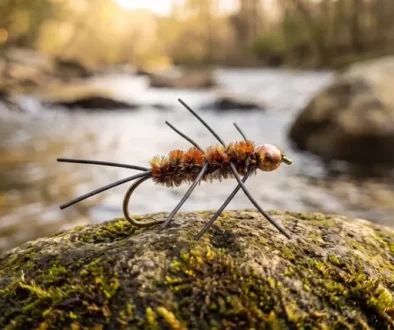
When the surface bite shuts down — bright sun, a cold front, heavy boat traffic on the bigger lakes — go subsurface with a small streamer, size 8-12, sparse and slow. A size 12-16 nymph, dead-drifted or fished under a small indicator near weed edges and drop-offs, will out-fish everything else on the toughest days. This upper Midwest region, more than the six states we covered in Parts One and Two, is genuine weed-and-rock country — deep, clear, glacially carved lakes with hard structure, not just soft farm-pond bottoms — so having a subsurface option that can get down and stay down matters more up here.
For the canoe-and-portage crowd:
and I say this from decades of hard-earned experience, pack light and pack smart. One rod, broken down and cased. A small fly box with the essentials above, not your entire collection. A spool of tippet, a few leaders, forceps, and nippers. That’s it. Everything else is dead weight on a portage trail, and I promise you, at some point on a 300-mile canoe trip, you will personally curse every single unnecessary ounce you packed. I know this because I did, repeatedly, at fourteen, and my Explorer Post leader was not shy about pointing it out.
Conventional tackle:
works exceptionally well throughout this whole region too — an ultralight spinning rod, 2 to 4-pound line, a small slip-bobber, and a live worm or a 1/64-ounce jig will produce fish on every single lake in this article. It’s also, frankly, the more practical choice for a canoe trip where space and weight matter more than style points.
One gear note specific to this region: bring split shot and a few different indicator sizes, more than you think you’ll need. The deep, clear, glacially formed lakes up here often hold their best bluegill well below the depth a floating popper can reach, especially by midsummer. A nymph that won’t get down isn’t fishing the right water, no matter how good the pattern is. I learned that lesson the hard way on more than one Wisconsin lake, fishing an unweighted nymph for an hour over fish I could see on the depth finder but never once actually reach.
Alright. Let’s talk water.
Michigan: The State That Made Bluegill Fishing a Childhood Rite of Passage
Michigan doesn’t just have good bluegill fishing — bluegill are, by a wide margin, the most commonly caught fish in the entire state. They live in every county, in water ranging from one-acre farm ponds to some of Michigan’s largest inland lakes, and more Michigan kids catch their first fish on a bluegill and a bobber than on anything else. I was one of them. That’s not sentimentality talking, either — trophy bluegill anglers up here will tell you a genuine 10-inch fish is one of the toughest freshwater trophies to catch consistently, precisely because bluegill grow so slowly. A 9-inch fish might be seven to ten years old. Every big one you catch has survived a long time to get that way.
The Michigan state record stands at 2 pounds, 12 ounces and 13.75 inches, caught in 1983 on Vaughn Lake in Alcona County — landed baitcasting with a small spinner, not even on the fly, which tells you something about how tough these fish are regardless of what you’re throwing.
For anglers chasing quality bluegill today, a handful of lakes consistently rise to the top:- Houghton Lake — widely considered the top overall bluegill destination in the state, regularly producing master-angler-class fish.
- Long Lake (Grand Traverse County) — a strong, consistent producer in northern lower Michigan.
- Wakely Lake — a quieter option near Grayling, well worth the drive.
- Gull Lake — a longtime favorite among Michigan panfish anglers, with a reputation that goes back generations.
- Lake Cadillac — reliable numbers and good average size.
And then there are the farm ponds — well-managed, lightly pressured, and, according to Michigan biologists, often home to the single largest individual fish in a given area. If you grew up here the way I did, you already know this. The famous lake gets the fishing pressure. The pond nobody talks about, tucked behind somebody’s back forty, gets the genuine hog.
How to fish it: Michigan’s bigger lakes — Houghton especially — reward a boat or kayak and some structure-hunting: submerged weed beds, drop-offs near shoreline points, and dock pilings. On the smaller lakes and farm ponds, you can work the entire shoreline on foot with that short 3-weight, popping tight to any wood or weed edge you find. Early summer, right around the spawn, is prime time statewide — the same window that had me skipping breakfast as a kid to get to the dock before anyone else woke up.
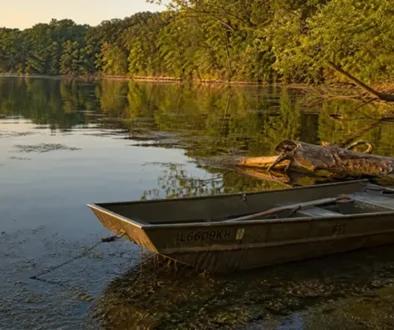
A note on Gull Lake specifically, because it’s the one that started all this for me. My grandfather kept a small aluminum boat there, older than I was, with an outboard motor that ran on what I can only describe as spite and stubbornness. He taught me to cast a fly rod off the bow of that boat before I was strong enough to properly load the rod on a backcast, which meant my early “casts” were closer to controlled collapses — the line would sort of pile up ten feet away and occasionally, almost accidentally, land a popper somewhere a bluegill could find it. It worked often enough that I never bothered fixing my form until years later, which any casting instructor will tell you is exactly the wrong way to learn, and also exactly how most of us actually learn. Gull Lake has changed some since then — different stocking programs, different pressure — but it still holds quality fish, and I still can’t fish it without thinking about that boat.
Don’t sleep on the lesser-known water either. Michigan’s DNR and longtime panfish anglers alike will tell you the well-managed private and small public ponds scattered statewide — the kind with no boat launch sign and no internet forum thread devoted to them — regularly produce the single biggest individual fish in a given county. If you know a farmer, a landowner, or a friend of a friend with a pond, that connection is worth more than any lake on this list. This is how I grew up and started fly fishing was farm ponds, bluegill, black bass, and perch. Pike in the larger bodies of water. And of coarse those acrobatic smallmouth bass.
Wisconsin: Sunfish Capital of the World, and a 300-Mile Canoe Trip I Still Think About
Wisconsin holds a genuinely wild claim to fame in the panfish world: Lake Onalaska, a 7,700-acre pool on the Mississippi River near La Crosse, carries the nickname “Sunfish Capital of the World,” and it earns it. The bluegill fishing there is renowned enough that anglers travel across state lines specifically to fish the lake’s backwater channels and emerging weed edges. If you only fish one lake in Wisconsin, that’s a legitimate case for making it this one.
The state record bluegill is 2 pounds, 9.8 ounces, 12 inches, caught in 1995 out of Green Bay in Brown County — proof that even Wisconsin’s massive, wind-blown big water can produce genuine giants among all the smallmouth and walleye it’s better known for.
Beyond Onalaska, Wisconsin’s bluegill water breaks down into a few distinct regions worth knowing:
Southern Wisconsin — the Madison chain:
- Lake Mendota — the largest lake in the chain at nearly 10,000 acres, and one of the best bluegill lakes in the entire southern half of the state. Average fish run 8-9 inches, with plenty pushing 10.
- Lake Monona — downstream of Mendota, known for outstanding panfish numbers and easy, accessible urban shore fishing.
Southeastern Wisconsin:
- Big Cedar Lake — a 941-acre Washington County gem, consistently ranked among the state’s top panfish lakes, with easy family-friendly access.
- Green Lake — deep and clear, home to bluegill exceeding 10 inches holding in the shallow weed beds through summer.
The Northwoods:
- Eagle River Chain — ten interconnected lakes totaling 3,240 acres, letting you fish multiple distinct waters in a single day. Catfish Lake, the largest in the chain despite the misleading name, is one of the system’s best.
- Minocqua Chain (Minocqua, Kawaguesaga, Tomahawk, and connected water) — the heart of Wisconsin’s classic Northwoods resort fishing tradition, with strong panfish populations throughout.
- Squirrel Lake — an Oneida County producer known for both numbers and quality.
- Chippewa Flowage — 14,593 acres, better known for musky and walleye, but carefully managed to also support excellent bluegill populations, and outstanding through the ice.
Now — the canoe trip. The Region 7 Explorer Post route I paddled as a teenager wound roughly 300 miles through exactly this kind of country: connected river systems and lake chains in the Wisconsin Northwoods, much of it upstream, all of it slow going with a loaded canoe and a portage pack that always seemed to weigh ten pounds more on day nine than it had on day one. We fished every evening we could, mostly because our food supplies were about what you’d expect from a group of teenage boys planning their own menus, and a stringer of bluegill off whatever lake we’d camped on made a real difference in morale. I couldn’t tell you the exact name of every lake we crossed that summer — forty-plus years and a few hundred other fishing trips have blurred some of that map — but I can tell you this: a bluegill caught on a hand-tied popper at the end of a twelve-mile paddling day, cooked over a camp fire with a group of exhausted, sunburned fourteen-year-olds, remains one of the best meals I have ever eaten in my life, and I have eaten in some genuinely nice restaurants since.
That trip also taught me something about equipment failure that no fly shop clerk ever adequately warns you about: everything you own will eventually get wet, dropped, sat on, or lost, usually all four in the same week. I went through two rod tips, one entire reel (long story, involving a rapid and a decision I still can’t fully defend), and roughly half my fly box before we were even halfway through the route. The survivors — the flies and gear that made it the full 300 miles — were, without exception, the simplest patterns and the sturdiest hardware I had. That’s stuck with me. To this day, when I’m putting together a travel kit for a client heading somewhere remote, I ask myself the same question that trip beat into me: would this survive a canoe portage with a tired, careless teenager? If the honest answer is no, it doesn’t go in the pack.
How to fish it: On the big southern lakes like Mendota and Onalaska, target weed edges and backwater channels with a popper early and late, switching to a streamer or nymph along deeper drop-offs midday. In the Northwoods chains, work timber and dock structure tight, the same way you would in Michigan — this is short-rod water, built for accurate, close-range casts, not long bombs across open water.
One more thing about that canoe route worth mentioning, because it shaped how I fish to this day: paddling upstream teaches you to read current in a way that flat lake fishing never will. Every eddy, every slack seam behind a rock, every slower stretch along an undercut bank becomes a place fish might be holding, whether you’re targeting bluegill, smallmouth, or just trying to figure out where the canoe wants to go versus where you want it to go. When our route dropped us into lake country after a long upstream stretch, I found myself instinctively reading the shoreline the same way — looking for the seam, the transition, the spot where two kinds of water met. That habit has never left me. I still catch myself doing it on salt water forty years later, scanning a flat for the exact kind of subtle edge that a fourteen-year-old with a canoe paddle taught himself to notice on a Wisconsin river.
Minnesota: Land of 10,000 Lakes, and a Fresh State Record
Minnesota just gave the entire bluegill world something to talk about. As of this year, the state record stands at 2.21 pounds, caught out of Big Stone Lake — a shallow, fertile, 12,600-acre border water shared with South Dakota — landed on a slip-bobber rig with a red worm. What makes it stranger still is that it’s the second record-class bluegill Big Stone Lake produced in the same season, after a different angler landed a 2-pound fish there just weeks earlier. Local fisheries biologists have said flatly they don’t see many bluegill like that come through — and when the state’s own DNR office is stunned twice in one summer by fish out of the same lake, that lake goes straight to the top of the must-fish list. Big Stone’s shallow, weed-choked, riverine structure — it’s technically the headwaters of the Minnesota River — is exactly the kind of nutrient-rich, cover-heavy water that grows fish like this.
Beyond Big Stone, Minnesota’s bluegill water is enormous and varied, but a few stand out:
- Pelican Lake (Orr, northern Minnesota) — genuinely known for trophy bluegills, shallow and productive, with June fish holding in lily pads, reeds, and cabbage weed.
- Kabetogama Lake (Voyageurs National Park area) — better known for crappie numbers, but holds solid bluegill too, especially in shallow evening bays.
- Bowstring Lake — a 9,500-acre panfish powerhouse in north-central Minnesota.
- Cass Lake — a consistent, well-known producer of quality panfish.
- Long Lost Lake (Clearwater County) — a smaller, 500-acre sleeper that’s quietly produced solid bluegill, crappie, and perch since the early ’90s.
- Lake Vermilion — long famous for trophy walleye, but its panfish populations have grown enough in recent years that it now ranks among the state’s better bluegill lakes as well.
And then there’s the Boundary Waters — the other canoe trip that shaped how I fish today, and one that deserves an honest caveat. The BWCA and the broader Canadian Shield country along Minnesota’s northern edge is not classic bluegill water. It’s cold, rocky, and built more for smallmouth bass, walleye, northern pike, and lake trout than for panfish. But the region isn’t entirely without them — the warmer, shallower bays on lakes like Crane Lake, Sand Point, and connected water near Kabetogama and Namakan do hold bluegill and other panfish, tucked in among the rock piles and structure that dominate up there. If you’re paddling through purely to chase bull bluegill, this isn’t your primary destination — but if you’re already up there for the smallmouth and the scenery, the way I was, don’t be shocked when a bluegill surprises you out of a weedy backwater you weren’t expecting to hold one.
I remember exactly one bluegill from that Boundary Waters trip, out of maybe a dozen total, because it came out of nowhere — a warm, shallow bay we’d stopped in to refill water bottles, miles from anything resembling farm-pond habitat, granite bedrock everywhere you looked. It hit a small popper meant for smallmouth, and for about four seconds I genuinely thought I had one of the lake trout everyone kept talking about, right up until an unmistakably round, spade-shaped body came up next to the canoe. My Explorer Post leader laughed at me for a solid ten minutes. Fair enough.
How to fish it: On Minnesota’s classic panfish lakes — Pelican, Bowstring, Big Stone — the approach mirrors everything else in this article: popper tight to weeds and cover when it’s calm, streamer or nymph deeper when it’s not. In Canadian Shield country, if you do find a warm bay holding fish, slow down and fish it thoroughly — those pockets of panfish habitat are rare enough up there that they’re worth working carefully rather than making one pass and moving on.
Minnesota is also worth a word on scale, because “Land of 10,000 Lakes” undersells it — the actual number of lakes in the state runs closer to 11,800, and that’s before you count the countless small ponds and backwaters that never make anyone’s official list. That’s the real gift of this region for a bluegill angler: you will never, in one lifetime, run out of new water to try. I fished maybe two dozen different lakes across Minnesota by the time I turned nineteen and I’d guess I hadn’t scratched one percent of what’s actually out there. If you’re the type of angler who gets restless fishing the same water twice, Minnesota alone could occupy you for the rest of your life and you’d still die with lakes left to explore.
Reading the Season Across Three States
One thing that took me years to fully appreciate, having grown up fishing all three of these states rather than just visiting them, is how much the calendar shifts as you move north. Bluegill in southern Wisconsin, around Madison, are often spawning and shallow well before fish in northern Minnesota’s Canadian Shield lakes have even shaken off winter. If you’re planning a trip that spans this whole region — and given how good all three states are, you should — don’t assume one calendar works everywhere.
Early season (late May in the south, mid-to-late June in the north): This is spawn time, and it’s popper season almost everywhere bluegill are present. Fish move shallow onto sandy or gravel-bottom beds, get aggressive defending nests, and become about as catchable as they’ll be all year. Work the shoreline methodically, cast past the bed, and let the popper sit.
Midsummer: As water warms, fish often pull off the immediate shallows and hold on the first significant break — a weed edge, a drop-off, a dock in eight to twelve feet of water. This is prime streamer-and-nymph water. Poppers still work in early morning and evening low-light windows, but midday demands going subsurface.
Fall: Exactly like I mentioned with Ohio back in Part One, fall fishing up here can be outstanding and criminally underutilized. Fewer boats, cooling water that pulls fish back toward structure, and bluegill that seem to feed with a little more urgency as the season winds down. Some of my best days on Michigan and Wisconsin water happened in September and October, fishing lakes that had been elbow-to-elbow with boat traffic just weeks earlier and were, by fall, entirely mine.
Frequently Asked Questions: Michigan, Wisconsin & Minnesota Bluegill
What’s the best lake for trophy bluegill across Michigan, Wisconsin, and Minnesota? Houghton Lake in Michigan, Lake Onalaska in Wisconsin, and Big Stone Lake in Minnesota are the standout picks — all three are widely recognized as top-tier bluegill destinations in their respective states, and all three have produced genuine record-class fish.
Is the Boundary Waters good for bluegill fishing? Not primarily — it’s better known for smallmouth bass, walleye, northern pike, and lake trout in cold, rocky, structure-heavy water. Bluegill do turn up in warmer, shallower bays on some lakes, but anglers heading to the BWCA specifically for bluegill should look elsewhere first.
What’s the best time of year to fly fish for bluegill in this region? Late spring through early summer, during and just after the spawn, is prime across all three states — fish move shallow, get aggressive, and become highly catchable on poppers.
Can I fish for bull bluegill on a canoe trip without a lot of gear? Yes, and it’s arguably the best way to do it. A single broken-down 3-weight rod, a small fly box, and a spool of tippet is all you need — that’s exactly the kit that got me through a 300-mile canoe trip across Wisconsin as a teenager.
Where This Started
Six states down across three articles now, and if I’m honest, this one hit differently to write. Illinois, Ohio, Missouri, Nebraska, Kentucky, and Iowa are all genuinely excellent bluegill water — but Michigan, Wisconsin, and Minnesota are where I actually learned to read a weed edge, throw a tight loop under overhanging brush, and appreciate what a short rod and a long canoe portage can teach a kid about patience. If you’ve got a teenager in your life who thinks fishing is boring, take them up here. Put a popper rod in their hands. Let a two-pound bluegill change their mind the way it changed mine.
Gear Up for the Northwoods at Saltwateronthefly.com
Whether you’re fishing a Michigan farm pond, the Wisconsin Northwoods, or planning your own canoe route through Minnesota lake country, get outfitted right at Saltwateronthefly.com:
- Compact, canoe-friendly 3-weight setups — travel rods, lightweight reels, and everything built to break down and disappear into a portage pack.
- Poppers, streamers, and nymphs proven on real Northwoods water, not just tied to look good in a shop display.
- Guided trips and adventure travel bookings — from bluegill closer to home to the Fly Fishing the Rockies Head to Tail circuit, and international water in Chile, Argentina, Iceland, and Italy.
Pack light, fish hard, and go find out why a kid with a cheap rod and a canoe full of gear he didn’t need still remembers every one of these lakes forty years later. Tight lines.