Montana’s Classic Stonefly Bench: The Salmonfly Expedition — Chasing the Hatch Across the Pacific Northwest
Series: Montana’s Classic Stonefly Bench — Article 8
Here is a thing that almost nobody does and everyone should.
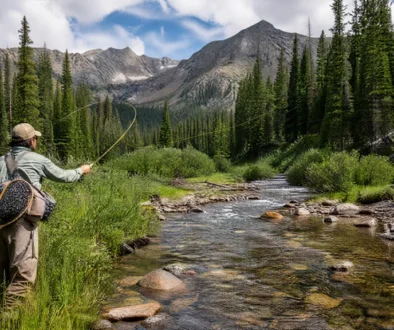
Instead of picking one river and one weekend and hoping the salmonfly hatch cooperates with your calendar, you point the truck at the earliest water in the region, fish the hatch where it starts, and then follow it. North. Upstream. Uphill. For as long as your vacation days, your marriage, and your tolerance for gas station coffee will permit.
The salmonfly hatch does not happen. It travels. It starts low and moves up — two to five miles a day on any given river, and across the Pacific Northwest as a whole it climbs from the lower canyons in late April to the high tributaries in early July. That is roughly ten weeks of Pteronarcys californica somewhere in the region at any given moment, and every single one of those weeks is happening on a river you could be standing in.
Most anglers fish the salmonfly hatch for four days a year. The hatch is available for seventy. This is a scheduling problem, not a fishing problem, and it can be solved by anyone willing to sleep in a truck.
I have done pieces of this trip over the years without ever assembling it into one continuous run. The Yakima from a drift boat. The Grande Ronde. The John Day. The Deschutes and the Metolius from those long weekends out of Salem that Article 4 covered. What follows is the trip I would build if I strung all of those pieces together into one deliberate expedition — the route, the timing, the water, the flies, and the side trips that most people drive straight past on their way to somewhere with a reputation.
This is Article 8 of Montana’s Classic Stonefly Bench. It is less a tying manual than a battle plan. Bring the flies from Articles 1 through 7. You’ll need most of them.
Table of Contents
The Premise: The Hatch Is a Moving Target and You Should Move With It
The mechanics are simple and they are the same on every river in the West.
Salmonfly nymphs migrate to the banks when water temperature climbs into the low fifties. They crawl out onto rocks and streamside vegetation, split their nymphal shucks, and emerge as adults. The adults spend several days in the willows and grasses doing whatever it is that salmonflies find compelling, then the females return to the water to deposit eggs — which is when they become available to trout in numbers that turn ordinarily sensible fish into surface-feeding lunatics.
Water temperature is the trigger. Fifty-four to fifty-eight degrees is the number. Not a date. Not a weekend that worked three years ago. Temperature.
Because temperature climbs from downstream to upstream and from low elevation to high, the hatch marches accordingly. On a single river it moves two to five miles per day. Across a region it moves for two months. Your job on this expedition is to stay ahead of it, on it, or just behind it — and to know the difference, because each position fishes differently:
Ahead of the hatch — nymphs are migrating, adults haven’t emerged. Fish big stonefly nymphs deep and tight to the bank. Kaufmann’s Rubberlegs from Article 5, the Girdle Bug from Article 7, Pat’s Rubber Legs. This is often the most productive fishing of the entire trip and almost nobody does it on purpose.
On the leading edge — first adults on the water, fish haven’t been pounded yet. This is the sweet spot. Size 4 dries, aggressive takes, fish that have not yet developed opinions. If you find the leading edge, do not tell anyone. Do not post it. Fish it.
Behind the hatch — adults have been on the water a week or more, boats have been through, fish have seen everything. Downsize. Size 6 and 8. Switch to the Improved Bird’s Stone from Article 2 for its lower profile, or go to a golden stone pattern as the goldens start overlapping. Fish the water nobody floated.
The expedition works because you are never stuck in the “behind” phase. When the fish get educated, you drive.
The Route: Six Weeks, Four Rivers, One Bug
This is built as a full expedition. It also breaks cleanly into individual long weekends if your life is the kind that has obligations in it.
Leg One — The Lower Deschutes, Late April into Mid-May
Where: Maupin downstream, and ideally below Trout Creek.
Why first: The lower Deschutes canyon is low elevation, warms early, and reliably produces the region’s earliest significant salmonfly activity. The hatch starts down near the mouth and climbs. Article 4 covered this river in full — the Deschutes Canyon Stone with its foam underbody and rubber legs is the pattern, in size 4.
The move: Float below Trout Creek if you can arrange it. The road section around Maupin gets the traffic; the wild and scenic stretch does not. Thirty-five miles, one way in, downhill in a boat. It is a commitment and it is the correct commitment.
Watch for: Rattlesnakes on the basalt. This is not a colorful detail. Watch where you put your hands when you’re scrambling on the rocks and watch where you step when you’re walking the bank in warm afternoon sun.
Side Trip: The Metolius
Where: Camp Sherman, below the springs at Black Butte.
Why: Because it is an hour and a half from Maupin and it is the most beautiful river in Oregon and it fishes nothing like the Deschutes. The Metolius comes out of the ground at a constant cold temperature, which means its hatch timing doesn’t follow the same rules as everything else on this trip. Golden stones and little yellow stones in the first eleven miles below the springs, technical presentation, fish that require you to be good.
The point of the detour: After three days of throwing size 4 orange bricks at Deschutes redsides, the Metolius will remind you how to actually fish. It is a palate cleanser. It is also a humbling, and you will be better on the next river for it.
Leg Two — The Yakima, Mid-May into Early June
Where: The Yakima Canyon between Ellensburg and Roza, or the upper river above the Cle Elum confluence.
Why here now: Washington’s blue-ribbon trout river, and the salmonfly hatch in May is brief but genuinely spectacular. The hatch starts in the lower canyon and moves upstream over two to three weeks, which means the river itself gives you two to three weeks of chase within a single drainage.
How to fish it: From a drift boat, casting tight to the bank. This is the essential Yakima technique in every season and it is doubly true during the salmonfly hatch, when the fish are stacked against the bank waiting for bugs to fall out of the willows. Twelve inches off the bank or you’re not fishing. Run and gun — cover water, hit structure, keep the fly in the productive zone and don’t fall in love with any single run.
Flow note: The Yakima is reservoir-controlled and doesn’t blow out unpredictably from rainstorms, which makes it more plannable than a true freestone. But spring runoff still pushes flows up hard. Above 4,000 cfs, wading is essentially finished and a boat becomes mandatory. Check the Umtanum gauge before you commit.
The pattern: Size 4 to 6 dries tight to the bank. The Chubby Chernobyl from Article 5 and the Kaufmann Stimulator from Article 2 both shine here. Pat’s Rubber Legs in size 8 to 10 for the pre-hatch and for dropper work.
The bonus: The Yakima has genuine hatch diversity — Green Drakes in June on the upper sections, March Browns earlier, caddis throughout. You are unlikely to have a day with nothing happening.
Leg Three — The Grande Ronde and the Wallowa, Mid-June into Early July
Where: Northeast Oregon, the Grande Ronde from the Wallowa confluence downstream, and the Wallowa itself.
Why here now: This is the best-kept secret on the entire route. The Grande Ronde and the Wallowa have a world-class golden stonefly hatch in mid-June to early July, and while the rest of the region is talking about the Deschutes, trophy rainbows here are exploding out of fast water for large top-water dries.
Why it matters to this expedition: By mid-June, the salmonfly hatch has moved off the lower rivers and the goldens are taking over region-wide. The Grande Ronde is where that transition fishes best. Switch to the Golden Stimulator from Article 3 in sizes 6 and 8. The 90-fish Rock Creek day and the 80-fish North Fork day that Article 3 covered? This is the Pacific Northwest version of that water.
The character of it: The Grande Ronde is born in the Elkhorn Mountains and runs 200 miles through wild mountain canyons that are inaccessible for long stretches except by raft or drift boat. Remote. Serious. The fishing is worth the logistics.
The multi-day option: Three to four day float trips are the standard here for the spring stonefly season. If your expedition has room for one extended float, make it this one.
Side Trip: The Minam, the Lostine, and the Imnaha
Where: The Wallowa Mountains, northeast Oregon, all within reach of the Grande Ronde.
Why: These are low-pressure wild trout gems draining the Wallowas, and almost nobody fishes them because everybody is on the Grande Ronde. Small water. Wild fish. Attractor dries. The Yellow Humpy from Article 6 is the fly, in size 10 or 12, fished upstream tight to structure on a 3-weight.
The point: After a four-day float on big water throwing size 6 goldens from a boat, one afternoon on the Minam with a small rod recalibrates everything. This is the same principle as the Metolius detour, applied at the other end of the trip.
Leg Four — The John Day, Late June (and the Pivot)
Where: North Fork John Day, and the upper mainstem.
Why here now: The John Day is the wild card of this route. The upper watershed holds genuinely good trout fishing and it is the least pressured water on the entire expedition. Golden stones and yellow sallies through late June.
The honest note: The lower John Day warms considerably by late June and turns into one of the best smallmouth bass fisheries in Oregon. If you arrive and the trout water is too warm to fish ethically, that is not a failed leg — that is the river telling you to switch species for two days. A size 6 Chubby Chernobyl catches smallmouth with an enthusiasm that will make you question several of your convictions about what constitutes real fly fishing.
Do not fight this. Fishing warm water for trout when the water is too warm for trout is how you kill fish you intended to release. Read the thermometer, respect it, and go catch bass.
The Expedition Fly Box
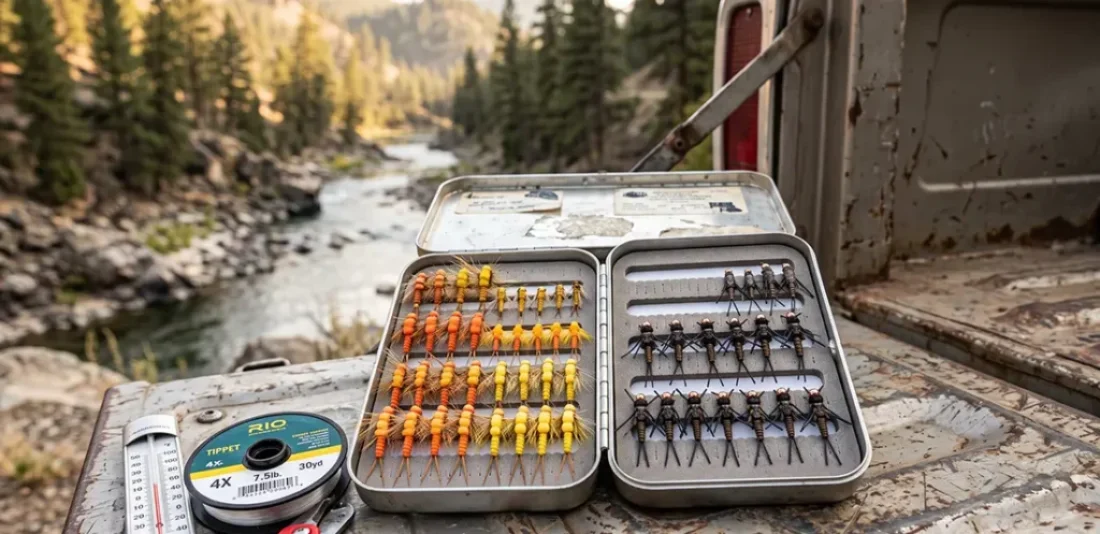
Everything on this route comes from patterns already covered in this series. That is not laziness — it is the point. Eight articles in, you have a complete western stonefly box. Here is what to pull for this trip:
Dries — Salmonfly (size 4–6)
- Deschutes Canyon Stone (Article 4) — foam underbody, rubber legs, the workhorse
- Improved Sofa Pillow (Article 1) — high floating, big profile, fresh-hatch fish
- Improved Bird’s Stone (Article 2) — lower profile, for pressured water
- Chubby Chernobyl, orange (Article 5) — indestructible, doubles as an indicator
Dries — Golden Stone (size 6–10)
- Golden Stimulator (Article 3) — the Grande Ronde and Wallowa pattern
- Chubby Chernobyl, tan (Article 5)
Dries — Small and Technical (size 10–16)
- Yellow Humpy (Article 6) — small streams, side trips, the Wallowa tributaries
- Little Yellow Stone (Article 3) — Metolius, late-season, selective fish
- Amy’s Ant (Article 7) — when stoneflies, hoppers, and caddis all overlap
Nymphs — The Pre-Hatch Weapon (size 4–10)
- Kaufmann’s Rubberlegs (Article 5) — the deep-water producer
- Girdle Bug (Article 7) — simple, heavy, effective
- Double Bead Peacock Stone (Article 6) — when you need to get down fast
Tippet and leaders: 7.5 feet of 2X or 3X for everything big. A 9-foot 4X/5X setup for the Metolius and the small-stream side trips. Bring more 3X than you think. Wind and willows will take it.
Ten Rules for the Salmonfly Expedition
1. Chase temperature, not dates. Fifty-four to fifty-eight degrees. Buy a stream thermometer, use it every morning, and let it make your decisions.
2. Call the fly shops. Every morning if you can. The people behind the counter in Maupin, Ellensburg, and Enterprise know exactly where the hatch is today. This information is free and it is worth more than any article, including this one.
3. Fish the bank. Twelve inches. Not three feet. Salmonflies fall out of streamside vegetation, which means the fish are waiting directly beneath streamside vegetation. Every foot you drift away from the bank is a wasted foot.
4. The leading edge is worth driving for. If the hatch is four hours upstream and blown out where you are, drive the four hours. The truck is a fishing tool.
5. Bring a nymph rig and use it. The pre-hatch nymphing window is the most underfished opportunity on this entire route. Big stonefly nymphs, tight to the bank, deep. This catches fish when the dry fly does nothing.
6. Downsize when they get educated. After a week of pressure, size 4 stops working and size 6 or 8 starts. This is not a failure of the pattern. It is the fish doing their job.
7. Take the side trips. The Metolius, the Minam, the small water you drive past. The expedition is better for the contrast and you’ll fish the big water better afterward.
8. Respect the thermometer for the fish’s sake, not just yours. Water above 68 degrees means stop fishing for trout. Late June on the lower John Day, this matters.
9. Sleep in the truck at least twice. Not for authenticity. Because the boat ramps you want to be on at 6 a.m. are two hours from the nearest motel and the fishing at 6 a.m. is the fishing you drove out here for.
10. Do not tell anyone where the leading edge is. You can post the fish. You can post the scenery. You can post the truck. The location stays with you and the two people you fish with.
Reason This Trip Is Worth Building
Somewhere in the middle of a trip like this — probably on the Grande Ronde, probably on day four when your casting arm hurts and your rain jacket hasn’t been dry since Tuesday — you stop thinking about the fly.
That is the whole point. Eight articles into this series, the tying instructions have done their work. You know why the wing lies flat. You know why the foam underbody matters on big water and why the dubbed underbody matters on the Henry’s Fork. You know when to downsize and why the Bird’s Stone outfishes the Sofa Pillow on pressured fish. That knowledge stops being something you think about and becomes something you simply have, the way you have the ability to read a seam or judge a distance.
What’s left after that is the river, the bug, and the fish. Which is what Pat Barnes was after in West Yellowstone when he sat down to fix a fly that wasn’t working. Not innovation. Not a pattern with his name on it. Just a better answer to a problem the river was posing.
The salmonfly hatch poses that problem for ten weeks a year across a thousand miles of the American West. Go answer it.
What’s Next in the Series
Montana’s Classic Stonefly Bench has covered Montana, Oregon, Utah, Idaho, Wyoming, Colorado, and now the full Pacific Northwest circuit. Article 9 goes back to the bench — a complete stonefly box breakdown, the materials that matter, and the tying order that produces a full season’s flies in a winter of evenings.
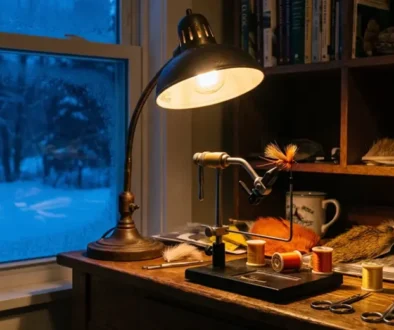
Every article in this series has been about a river. The next one is about the vise.
← Article 7: Colorado — Cheesman Canyon, the Frying Pan, the Roaring Fork & the Arkansas Article 9: The Complete Stonefly Box — Coming Soon →
Montana’s Classic Stonefly Bench is an ongoing series covering the foundational western stonefly patterns from the tiers who built them.