Alabama Fly Fishing: Largemouth Giants, Tennessee River Smallmouth, and a Gulf Coast Nobody’s Talking About
Alabama fly fishing doesn’t get the respect it has earned, and that gap between reputation and reality is one of the more useful disconnects in freshwater fly fishing right now. While the rest of the country is fighting over access on name-brand tailwaters and planning trips to waters that appear in every fly fishing publication printed in the last decade, Alabama has been quietly growing some of the largest largemouth bass in the United States, running a Tennessee River smallmouth fishery that belongs in the regional conversation, and developing a Gulf Coast saltwater fly fishing scene that most people outside the state haven’t fully processed yet. Alabama fly fishing is not a consolation prize. It is a destination that hasn’t been priced and pressured into irrelevance yet. That window will not stay open indefinitely.
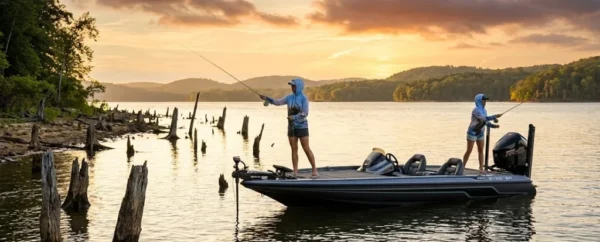
Start with the largemouth bass, because in Alabama that is where every honest fly fishing conversation begins. The Tennessee River impoundments that cross northern Alabama — Guntersville, Wheeler, Wilson, Pickwick — collectively represent one of the largest and most productive largemouth bass fisheries in the country, and Lake Guntersville alone has produced enough tournament-winning, record-threatening largemouth to establish itself as a legitimate bucket list fishery regardless of what tackle you prefer. Alabama largemouth fly fishing in the hydrilla and milfoil beds of the Tennessee River impoundments is a weedless fly game — deer hair frogs, large weedless Deceivers, and surface poppers worked through vegetation cover that grows thick enough to hide fish the size of your forearm. These are not average bass. Alabama’s Tennessee River system grows largemouth on a diet of abundant shad, crawfish, and bluegill in warm, fertile, heavily vegetated water, and the results show up in the fish.
The Tennessee River itself — and the water in between the impoundments, the tailraces below each dam — is where Alabama fly fishing for smallmouth bass makes its case. The tailrace below Wilson Dam on Pickwick Lake and the shoal areas of the Tennessee River below the lock and dam system hold smallmouth bass in current-swept, rocky water that produces fish of a size and quality that most Alabama anglers drive past in pursuit of largemouth. Alabama Tennessee River smallmouth are underutilized, underappreciated, and exactly the kind of fly rod target that rewards the angler willing to show up with a sink-tip line and a crayfish pattern instead of the standard reservoir bass setup.
Central Alabama introduces a different fly fishing character — the Coosa River system and its impoundments, Lay Lake, Mitchell Lake, Weiss Lake, and Logan Martin Lake, provide a mix of spotted bass, largemouth bass, and the Coosa bass — a species endemic to the Coosa River drainage that is genetically distinct, behaviorally aggressive, and almost entirely unknown outside the region. Coosa bass fly fishing on the Coosa River system is a legitimate reason to make the trip to central Alabama on its own merits, and the spotted bass fishery in Weiss Lake — called the Crappie Capital of the World in the marketing materials, which undersells the bass fishing badly — is worth far more fly rod attention than it receives.
Southern Alabama transitions the fly fishing story from freshwater to salt, and the Mobile Bay system — the four-river delta of the Alabama, Tombigbee, Cahaba, and Black Warrior Rivers entering the Gulf of Mexico — is the most productive and most complex estuarine system on the northern Gulf Coast. Alabama saltwater fly fishing in Mobile Bay and the coastal waters of Baldwin County is a speckled trout, redfish, and flounder game in the grass flats, oyster reefs, and tidal marshes of the bay’s eastern shore, with the added bonus of Spanish mackerel, false albacore, and jack crevalle on the fly in the passes and nearshore Gulf waters during the warmer months. The Perdido Bay system on the Florida-Alabama border and the Wolf Bay and Bon Secour Bay areas of Baldwin County provide additional saltwater fly fishing access with less pressure than the primary Mobile Bay fisheries.
Alabama fly fishing is a state-sized argument for paying attention to water that hasn’t been written about enough. The fish didn’t get that memo.
Target Species: Largemouth Bass, Smallmouth Bass, Spotted Bass, Coosa Bass, Striped Bass, Redfish, Speckled Trout, Flounder, Spanish Mackerel Best Seasons: February–May (largemouth spawn) | June–September (smallmouth, coastal) | September–November (fall bass, Gulf Coast) Notable Waters: Lake Guntersville, Pickwick Lake, Wheeler Lake, Weiss Lake, Coosa River, Mobile Bay, Perdido Bay, Bon Secour Bay