Montana’s Classic Stonefly Bench: The Complete Box — A Winter of Evenings, A Season of Flies
Series: Montana’s Classic Stonefly Bench — Article 9
Eight articles of rivers. One article about the vise.
Everything in this series up to now has been about water — Pat Barnes on the Madison, Cal Bird’s segments, the Henry’s Fork exposing what the original Bird’s Stone couldn’t survive, Rock Creek in July, the Miracle Mile in Wyoming wind, Cheesman Canyon humbling everyone who walks into it. Rivers first, patterns second. That was the correct order, because a fly that doesn’t come from a river is just a craft project with a hook in it.
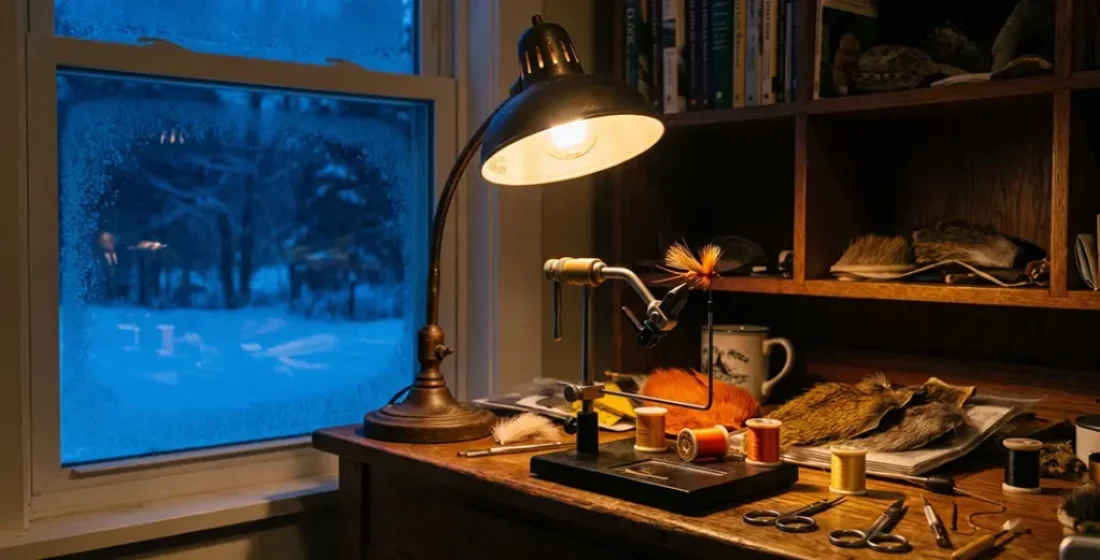
But there comes a night in January when the rivers are locked up, the season is five months out, and the correct response to that situation is not to browse fishing reports from last June. It is to sit down at the bench and build the box.
This is the article about that.
Not one more pattern. Not one more river. The complete stonefly box — what goes in it, how many of each, what materials you actually need versus what the catalogs would like you to believe you need, and the tying order that turns a winter of evenings into a season’s worth of flies without producing the specific kind of burnout that comes from tying forty-eight identical size 6 Stimulators in one sitting.
You will not do this in a weekend. You should not try. Twenty evenings at ninety minutes each is a season’s box, and twenty evenings between Thanksgiving and March is not an ambitious schedule. It is a Tuesday habit.
This is Article 9 of Montana’s Classic Stonefly Bench. Put on something with a long track listing. Pour whatever you pour. Let’s build the box.
Table of Contents
What Actually Goes In the Box
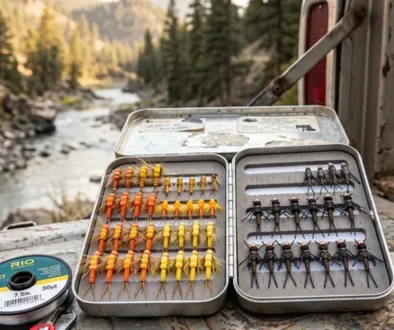
Every pattern below came from an earlier article in this series. Nothing new. The counts assume a full western season — spring Skwala through October Caddis — with enough margin for the flies you will lose in willows, break off on rocks, and give away to the person in the next boat who is having a worse day than you.
If you fish twenty days a year, run these numbers. If you fish sixty, multiply by two. If you guide, you already know your own numbers and you stopped reading recommendations like this a decade ago.
Salmonfly Dries — 36 flies
| Pattern | Sizes | Count | Article |
|---|---|---|---|
| Deschutes Canyon Stone | 4, 6, 8 | 12 | 4 |
| Improved Sofa Pillow | 4, 6 | 8 | 1 |
| Improved Bird’s Stone | 4, 6, 8 | 8 | 2 |
| Kaufmann Stimulator, orange | 4, 6 | 8 | 2 |
Reason this mix: The Deschutes Canyon Stone is the workhorse — foam underbody, rubber legs, floats all day, survives abuse. The Sofa Pillow is your high-floating fresh-hatch fly for broken water. The Improved Bird’s Stone is what you tie on when the fish get educated and the size 4 starts drawing refusals. The Stimulator covers everything in between and doubles as a golden stone when you run out of yellow ones. Four patterns, four different jobs, no redundancy.
Golden Stone Dries — 24 flies
| Pattern | Sizes | Count | Article |
|---|---|---|---|
| Golden Stimulator | 6, 8, 10 | 12 | 3 |
| Chubby Chernobyl, tan | 6, 8, 10 | 12 | 5 |
Reason this mix: The golden stone hatch runs longer than the salmonfly hatch and gets fished less. These twelve Golden Stimulators are the flies behind the 90-fish Rock Creek day and the 80-fish North Fork day. The Chubby Chernobyl carries a dropper and floats forever, which makes it the fly you reach for when you want to cover two zones at once.
Small Stones & Attractors — 30 flies
| Pattern | Sizes | Count | Article |
|---|---|---|---|
| Yellow Humpy | 10, 12, 14 | 12 | 6 |
| Little Yellow Stone | 12, 14, 16 | 10 | 3 |
| Amy’s Ant | 8, 10 | 8 | 7 |
Why this mix: The Humpy is your small-stream and side-trip fly — high country, backroads, anywhere a 3-weight makes more sense than a 5. The Little Yellow Stone extends your dry fly season into September when everyone else has quit. Amy’s Ant is the midsummer answer when stoneflies, hoppers, and caddis are all on the water and the fish haven’t picked a side.
Skwala & Early Season — 12 flies
| Pattern | Sizes | Count | Article |
|---|---|---|---|
| Skwala Stone | 8, 10, 12 | 12 | 3 |
Why this many: Because February and March fishing is uncrowded, the fish are hungry, and twelve flies is enough for the entire early season on the Bitterroot, Clark Fork, Blackfoot, and Yakima. This is the cheapest twelve flies in the box in terms of fish-per-fly returned.
Stonefly Nymphs — 36 flies
| Pattern | Sizes | Count | Article |
|---|---|---|---|
| Kaufmann’s Rubberlegs | 4, 6, 8 | 14 | 5 |
| Girdle Bug | 6, 8, 10 | 12 | 7 |
| Double Bead Peacock Stone | 6, 8 | 10 | 6 |
Reason this many nymphs: Because the pre-hatch window is the most underfished opportunity in western stonefly fishing and because you will lose nymphs to the bottom at roughly three times the rate you lose dries to willows. This is the section of the box that empties fastest and matters most on the days when nothing is coming off.
October Caddis — 8 flies
| Pattern | Sizes | Count | Article |
|---|---|---|---|
| October Caddis Stimulator | 6, 8 | 8 | 4 |
Reason it’s in a stonefly box: Because it ties on identical logic, fishes identical water, and extends your season into late October on the Rogue, the Deschutes, and the Metolius. Eight flies, two months of extra fishing.
Box total: 146 flies. That is a full western season across seven states and roughly eight months of fishable stonefly water. At ninety minutes an evening, that’s twenty evenings.
The Materials That Actually Matter
Here is the uncomfortable truth about fly tying materials: you can spend two thousand dollars building a bench and still tie mediocre flies, or you can spend three hundred on the right things and tie flies that catch fish for a decade. The difference is knowing which materials carry the fly and which ones are decoration.
Hackle — Where the Money Goes
This is the one place where cheap materials produce visibly worse flies. Ewing Dry fly hackle is the structural component that holds a size 4 Sofa Pillow up in fast water all day. Bad hackle is webby at the base, inconsistent in barb length, and produces a fly that sits wrong from the first cast.
What you need:
- Brown saddle — the single most-used hackle in this box. Palmered bodies, front collars, thorax hackle. Buy a full saddle in a size range covering hooks 4 through 10.
- Grizzly saddle — Stimulator thorax hackle, Humpy collars. The barred pattern creates a light interaction that solid colors don’t.
- Dark brown or furnace — Skwala, Bird’s Stone, Improved Bird’s Stone. Darker patterns need darker hackle and substituting medium brown looks wrong.
- Light ginger or cream — Little Yellow Stone, Green River Tan Caddis. Small sizes, fine barbs.
Ewing Hackle is what I use and recommend. The barb consistency across a saddle is what matters when you’re tying twelve flies in a sitting and you want number twelve to look like number one.
Elk Hair — Know Your Grades
Elk hair is not one material. It’s four, and using the wrong grade is the most common reason a fly looks wrong for reasons the tier can’t identify.
- Natural cow elk, medium — the workhorse. Wings on the Sofa Pillow, Bird’s Stone, Deschutes Canyon Stone. Hollow, stiff, floats.
- Fine natural elk — Improved Bird’s Stone wings, Little Yellow Stone. Finer fiber compresses into a cleaner downwing silhouette.
- Bull elk, coarse — tails on large patterns where you need stiffness and don’t want flare.
- Bleached or light elk — Little Yellow Stone, Green River Tan Caddis. Pale wings on pale flies.
- Dyed elk — orange, gold, olive-brown — Bird’s Stone abdomens, Skwala bodies, Golden Stimulator tails.
Buy patches, not packets. A patch lets you select fiber diameter from different areas of the hide. Packets give you whatever was left over.
Foam — Buy Fly Tying Foam
2mm closed-cell fly tying foam in orange, tan, black, and yellow. This is not the same thing as craft store foam and the difference shows up immediately: fly tying foam has consistent density, compresses and rebounds correctly under thread pressure, and holds its shape after being crushed in a fish’s mouth. Craft foam does not. It’s an eight-dollar difference across an entire season.
Dubbing — Three Types, Not Thirty
- Antron or Haretron in orange, burnt orange, yellow, gold, olive-brown, cream — dry fly bodies across nearly everything in this box.
- SLF or dark synthetic dubbing in black and dark brown — nymph thoraxes.
- Fine dubbing in pale yellow and tan — the small stuff, size 14 and 16.
That’s it. Six colors of one dubbing type, two of another, two fine. The rest of the dubbing wall at the shop is for other people’s flies.
Rubber Legs
Barred rubber legs in brown, black, and orange. Medium diameter for size 4 through 8, small for size 10 and smaller. These are cheap and they transform static patterns into moving ones. Do not skip them and do not trim them short.
Wire, Thread, Beads, Hooks
- Wire: fine copper and fine gold. Ribbing on nymphs.
- Thread: UTC 140 in orange, yellow, black, olive-brown. UTC 70 in the same colors for size 12 and smaller.
- Beads: tungsten, black and gold, sized 7/64 through 5/32.
- Lead wire: .015 and .020.
- Hooks: Tiemco 5212 (2X dry), 200R (3X curved), 5263 (3X nymph), 2302, and TMC 100 for small dries. Five hook models cover this entire box.
The Winter Tying Order
Here is where most tiers go wrong: they tie by pattern. Twelve Deschutes Canyon Stones, then twelve Golden Stimulators, then twelve Girdle Bugs. This is efficient in theory and miserable in practice, because by fly number nine of anything you’ve stopped paying attention and quality drops measurably.
Tie by technique block instead. Group patterns that share construction methods so your hands stay in one motor pattern while your brain stays engaged, and rotate blocks before fatigue sets in.
Block One — Nymphs (Evenings 1–5)
Start here. Nymphs are forgiving, the counts are high, and it gets you back into rhythm after months away from the vise.
- Evening 1: Girdle Bug × 12 — simplest pattern in the box, pure rhythm work
- Evening 2: Kaufmann’s Rubberlegs × 7
- Evening 3: Kaufmann’s Rubberlegs × 7
- Evening 4: Double Bead Peacock Stone × 5
- Evening 5: Double Bead Peacock Stone × 5
Reason first: All three share weighted underbodies, chenille or herl bodies, wire ribs, rubber legs, and wingcase construction. One motor pattern, three flies, thirty-six pieces of the box done in five evenings.
Block Two — Foam Bodies (Evenings 6–10)
- Evening 6: Deschutes Canyon Stone × 6
- Evening 7: Deschutes Canyon Stone × 6
- Evening 8: Chubby Chernobyl × 12
- Evening 9: Amy’s Ant × 8
- Evening 10: Overflow — finish anything from evenings 6–9, or tie the Frying Pan Salmonfly Special variants
Reason grouped: Foam handling is its own skill. Cutting consistent strips, binding without over-compressing, segmenting evenly, trimming heads. Five consecutive evenings of foam work and you’ll be measurably better at it than you were in November.
Block Three — Palmered Elk Hair Dries (Evenings 11–15)
- Evening 11: Improved Sofa Pillow × 8
- Evening 12: Improved Bird’s Stone × 8
- Evening 13: Skwala Stone × 12
- Evening 14: Kaufmann Stimulator, orange × 8
- Evening 15: Golden Stimulator × 12
Reason grouped: Stacked elk hair, palmered hackle, dubbed or segmented bodies, flat or divided wings. This is the technical heart of the box and it deserves your best attention. Do not tie this block tired.
Block Four — Small & Fine (Evenings 16–20)
- Evening 16: Yellow Humpy × 6
- Evening 17: Yellow Humpy × 6
- Evening 18: Little Yellow Stone × 10
- Evening 19: October Caddis Stimulator × 8
- Evening 20: Overflow and repairs — replace anything from the season that got beat up, fill gaps
Reason last: Small flies demand the most precision and the least material tolerance. Save them for when your hands have twenty evenings of recent practice behind them. The Humpy in particular gets dramatically easier after a winter of elk hair work.
Bench Rules That Actually Improve Flies
Tie in daylight or under good light. Not lamp-in-the-corner light. A real tying lamp with daylight-temperature bulbs. Half the proportion errors tiers make are visibility errors.
Stop after ninety minutes. Quality degrades measurably after that and you’ll spend next season fishing flies you tied while checked out.
Tie the first one badly on purpose. Every session, the first fly is a warm-up. Accept that, tie it, put it in the practice pile, and start counting from number two.
Match hook to pattern, not to habit. Five hook models cover this entire box and each one is specified for structural reasons. A Stimulator on a straight-shank hook is a different fly and not a better one.
Proportions before materials. A cheap fly with correct proportions outfishes an expensive fly with wrong ones every single time. Measure the tail against the shank. Measure the wing against the tail. Every time until it’s automatic.
Head cement everything and let it cure. A fly tied in January and fished in June has had five months to cure properly. There is no excuse for an uncemented head on a winter-tied fly.
Keep the practice pile. Every fly that came out wrong goes in a separate box. Fish them on days when you’re breaking off on rocks anyway. They catch fish. Trout are not fly tying judges.
What This Actually Buys You
One hundred forty-six flies. Twenty evenings. Roughly three hundred dollars in materials if you’re starting from nothing and considerably less if you already have a bench.
What it buys is not the flies. Flies are cheap and you can buy them from a shop, including mine.
What it buys is that moment in June, standing in the Madison or the Yakima or the Grande Ronde with the hatch coming off and fish working the bank, when you tie on a size 4 that you built in January while snow came down outside — and the fly does exactly what you designed it to do, because you understood the problem when you tied it.
That’s what Pat Barnes was doing in West Yellowstone. Not tying flies. Solving problems in advance, at a bench, in the off-season, so that when the river asked the question he already had the answer in a box in his vest.
Nine articles ago this series started on his bench. It ends at yours.
Go build the box.
The Series
Article 1: The Improved Sofa Pillow & Bird’s Stonefly — Pat Barnes, Cal Bird, and where it all started
Article 2: The Improved Bird’s Stone & Kaufmann Stimulator — Lawson, Kaufmann, and the next generation
Article 3: Skwala, Golden Stimulator & Little Yellow Stone — The eight-month stonefly season
Article 4: The Deschutes & the Rogue — Oregon’s stonefly rivers
Article 5: The Green River & South Fork Boise — Tailwater technical fishing
Article 6: Wyoming — Lost, found, and catching cutthroat
Article 7: Colorado — Cheesman, the Pan, the Fork, and the Arkansas
Article 8: The Salmonfly Expedition — Chasing the hatch across the Pacific Northwest
Article 9: The Complete Box — You are here
← Article 8: The Salmonfly Expedition
Montana’s Classic Stonefly Bench is a nine-part series covering the foundational western stonefly patterns from the tiers who built them.