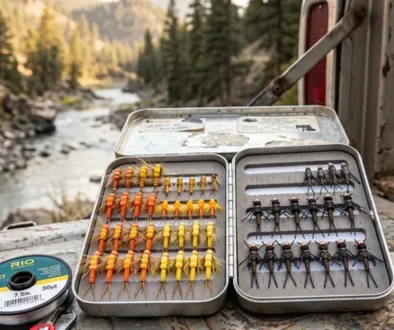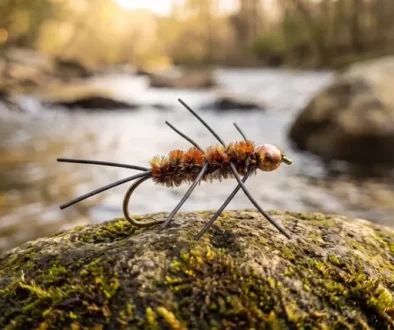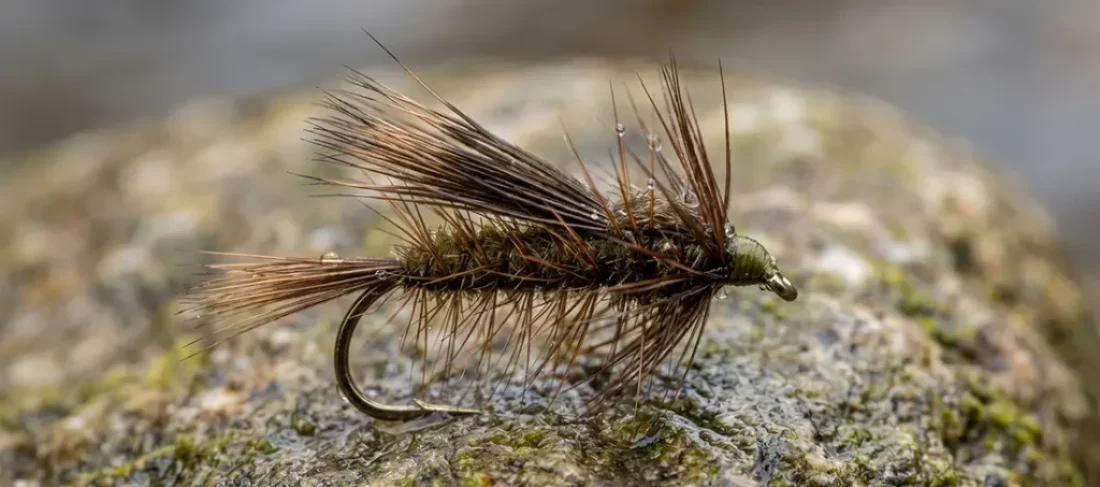
Montana’s Classic Stonefly Bench: The Skwala, the Golden Stimulator, and the Little Yellow Stone
Series: Montana’s Classic Stonefly Bench — Article 3
Most fly fishers think the stonefly season begins when the salmonflies show up in late May and ends sometime around the Fourth of July when the hatch moves off the big rivers and into the high country. They are wrong on both ends.
The stonefly season in the American West begins in February.
While the rest of Montana is still arguing about whether it’s worth driving to the river, the Skwala is already hatching on the Bitterroot, the Clark Fork, and the Blackfoot. Skwala americana — a dark olive-brown stonefly roughly half the size of a salmonfly — crawls out of the gravel, climbs the bankside rocks, and starts showing up on the water before most fly fishers have pulled their rods out of the closet. The fish know. They’ve been waiting since October for something large enough to bother rising to, and the Skwala is large enough. In March on the Bitterroot, a size 8 Skwala dry on a short leader over the right bank structure will catch fish that have every reason to refuse it and not enough experience yet with what fly fishers are doing to know better.
The stonefly season also doesn’t end in July. The golden stonefly hatch — Calineuria californica and Hesperoperla pacifica — runs through July and August on rivers across Montana, Idaho, and Wyoming, quieter and less dramatic than the salmonfly event but often more fishable because the crowds have gone home. And behind the goldens come the little yellow stones — the Chloroperlidae, the yellow sallies, the small pale stoneflies that most anglers walk past without recognizing — hatching through August and into September on rivers that are otherwise considered post-season water.
Three hatches. Three patterns. Six months of stonefly fishing that most people leave on the table.
This is Article 3 of Montana’s Classic Stonefly Bench. Articles 1 and 2 covered the salmonfly patterns that define May and June. This article covers everything else — the early season nobody fishes, the mid-season hatch that outlasts the crowds, and the late-season opportunity that extends dry fly fishing into September on water you’ll often have entirely to yourself.
Table of Contents
The Stonefly Calendar Nobody Follows
Understanding when each hatch happens and where is the difference between planning a season and stumbling into one. Here is the practical western stonefly calendar, river by river:
Skwala Hatch — February through April
- Bitterroot: Late February through March
- Clark Fork: Early March through April
- Blackfoot: Mid-March through April
- Rock Creek: Late March through April
Golden Stonefly Hatch — June through August
- Madison: Late June through July
- Gallatin: July through early August
- Yellowstone: July through August
- Henry’s Fork: Mid-July through August
- Most smaller Montana tributaries: July through mid-August
Little Yellow Stone Hatch — July through September
- Present on virtually every Montana river during midsummer
- Peak activity late July through August on most drainages
- Often the only surface activity on low, clear late-season water
The angler who understands this calendar doesn’t have a salmonfly season. They have a stonefly season that runs eight months out of twelve, on different rivers, with different patterns, and with dramatically different fishing pressure at each stage. The Skwala hatch happens on uncrowded water in cold weather. The little yellow stone hatch happens on late-season rivers when most anglers have convinced themselves the dry fly fishing is over. Both are opportunities the stonefly calendar hands you for free if you’re paying attention.
How to Tie the Skwala Stone
Reason This Fly Exists
The Skwala pattern exists because the fish are rising in March and there was nothing adequate to put on the end of the leader. Early tiers working the Bitterroot and Clark Fork in late winter discovered that the fish — starving after months of cold water and limited feeding — were willing to rise to Skwala americana adults with a recklessness they’d never show to a salmonfly during the height of summer. The problem was pattern selection. The salmonfly dries were too large and too orange. Standard dark stonefly nymphs were the wrong presentation entirely. A specific Skwala dry fly — olive-brown, size 8 to 10, low-riding and correctly profiled — was the answer.
The pattern that emerged, refined through seasons on the Bitterroot and Clark Fork, draws on the same elk hair foundation as everything else in this series. What distinguishes it is color and proportion — darker, smaller, and lower-riding than anything in the salmonfly box.
Hook & Materials
| Component | Material |
|---|---|
| Hook | Partridge, size 8–12 |
| Thread | Semperfli 6/0 Classic, olive brown |
| Tail | Dark elk hair or moose body hair, stacked |
| Abdomen | Olive brown dubbing — Haretron or SLF in dark olive |
| Abdomen Hackle | Dark brown or furnace dry fly hackle, palmered |
| Wing | Dark natural elk hair or deer hair, tied flat and low |
| Thorax | Dark olive brown dubbing, fuller than abdomen |
| Thorax Hackle | Dark brown dry fly hackle, 2–3 turns |
| Head | Olive brown thread |
Color note: The Skwala adult is a dark olive-brown insect — significantly darker than the salmonfly and noticeably darker than the golden stone. Match the dubbing color to the natural on your specific river. Bitterroot Skwalas tend toward darker olive. Clark Fork adults often show more brown. Collect a natural before you sit down at the bench.
Hook note: Drop to a size 10 or 12 on pressured spring creek water and educated fish. The Skwala is a smaller insect than most tiers account for and upsizing the pattern is the most common mistake on selective fish.
Tying Instructions
Step 1 — Hook and Thread Base
Mount a Partridge size 8 or 10 in the vise. Start olive brown thread at the eye and wrap a clean, tight base back to a point above the barb. Smaller hook, smaller thread — Semperfli 6/0 Classic keeps bulk manageable on this size range.
Step 2 — Tail
Stack a small, neat clump of dark elk hair or moose body hair until tips are aligned. The tail should be sparse compared to the salmonfly patterns in this series — the Skwala is a smaller, more compact insect and the tail should communicate that. Length equal to half the hook shank. Tie in with controlled wraps, trim butts at a taper, cover with thread.
Step 3 — Abdomen Hackle
Tie in a dark brown or furnace dry fly hackle by the tip at the tail tie-in point. Fiber length proportional to hook size — approximately 1.5 times the hook gap. Bind flat against the shank.
Step 4 — Dubbed Abdomen
Spin dark olive brown Haretron or SLF dubbing on the thread — enough for a moderately full abdomen, not heavy. The Skwala body is slimmer in profile than the salmonfly. Wrap forward to the two-thirds point in touching turns. Keep it neat. On a size 10 hook the margin for sloppy dubbing is smaller than on a size 4.
Step 5 — Palmer the Hackle
Wind the abdomen hackle forward through the dubbed body in three to four evenly spaced turns. The smaller hook requires slightly fewer turns to avoid crowding — judge by the spacing, not the number. Tie off at the front of the abdomen, trim the tip. Trim hackle fibers below the hook shank.
Step 6 — Wing
Select dark natural elk hair — darker fiber than the natural tan used on the salmonfly patterns. Stack until tips are even. The wing extends to the tip of the tail. Tie in flat and low directly in front of the abdomen. The Skwala is a low-riding, flat-winged adult in the same family as the salmonfly — the wing profile and presentation are identical in principle, compressed in scale.
Trim butts at a taper, cover with thread.
Step 7 — Thorax
Dub a fuller thorax of dark olive brown dubbing in front of the wing. More prominent than the abdomen, giving the fly the slightly hunched thorax profile of the natural adult. Two to three turns of well-loaded dubbing.
Step 8 — Thorax Hackle
Tie in a dark brown dry fly hackle in front of the thorax. Two to three turns forward, tie off, sweep rearward, hold with thread pressure while whip finishing.
Step 9 — Head and Finish
Small, clean olive brown thread head. Whip finish twice. Hard head cement.
Tying Notes
Fish the Skwala on the same short, stout leader you’d use for salmonfly dries — 7.5 feet, 3X tippet. The fish are aggressive in March and the water is often slightly off-color from snowmelt. Presentation precision matters less than pattern selection at this stage of the season. Get the color and size right and fish the likely bankside structure. The trout are not subtle in March. They haven’t eaten well since October.
The Skwala hatch often occurs during unsettled weather — warm afternoons that turn cold, wind that comes up without warning, overcast that breaks into hard bright sunshine and shuts the hatch off in an hour. Dress for the river in March, not for the temperature when you left the truck.
How to Tie the Golden Stimulator
Reason This Fly Exists
The golden stonefly hatch is the salmonfly hatch’s less dramatic, longer-running cousin — and on many western rivers it produces better dry fly fishing than the salmonfly event because the fish haven’t been hammered by two weeks of guided boats throwing size 4 orange dries at them. The golden stone adults are yellow to golden-amber in color, size 6 to 10 depending on species and river, and they hatch through the heat of summer when river pressure has dropped and the fish are feeding aggressively in the cooler morning and evening windows.
I know what this fly does on the right water because I’ve seen it do it. On Rock Creek during a golden stone hatch, I spent a day trolling a Golden Stimulator off the back of the raft between rowing stretches and landed 90 fish. Not memorable fish — just fish, one after another, the way the golden stone hatch produces when it’s right and you’re on the correct water at the correct time with the correct fly. Rock Creek in July with a size 8 Golden Stimulator is not a complicated equation. The fish solve it for you.
On the North Fork of the Flathead, a different river and a different day, 80 fish in six hours. Same fly, same hatch, same result. That is what the golden stone hatch does on Montana water that doesn’t see the kind of pressure the Madison and Gallatin absorb during the salmonfly season. The crowds go home after the Fourth of July and the fish get stupid again in the best possible way.
Tie this fly. Fish this hatch. Don’t tell too many people about it.
Randall Kaufmann’s Stimulator, covered in Article 2 in salmonfly colors, solves the golden stone problem by changing nothing about the construction and everything about the color. The tying method is identical — the same divided upright wing, the same dubbed abdomen, the same grizzly thorax hackle through dubbed thorax. What changes is the thread, the dubbing, and the tail color. One fly, two hatches, different rivers, different months.
Hook & Materials
| Component | Material |
|---|---|
| Hook | Partridge, 2-3X long, size 6–12 |
| Thread | Semperfli 6/0 Classic, yellow |
| Tail | Elk hair, dyed gold or yellow, stacked |
| Abdomen | Yellow or golden Antron dubbing |
| Abdomen Hackle | Ewing Hackle Brown saddle hackle, palmered |
| Wing | Natural elk hair, tied upright and divided |
| Thorax | Yellow or amber Antron dubbing, full |
| Thorax Hackle | Ewing Grizzly saddle hackle, palmered through thorax |
| Head | Yellow thread |
Color variations for golden stone:
- Early golden stone — June/July: Bright yellow abdomen, yellow thorax, brown abdomen hackle, grizzly thorax hackle
- Late golden stone — August: Amber or gold abdomen, amber thorax — the naturals darken as the season progresses
- High country golden stone: Smaller hook, same color, tied on a 200R size 10 or 12 for high-elevation tributaries where the insects are consistently smaller
Tying Instructions
The Golden Stimulator is tied using the identical method as the salmonfly Stimulator covered in Article 2. Follow those tying steps exactly — the only changes are:
- Thread color: yellow instead of orange
- Tail color: dyed yellow or gold elk hair instead of orange
- Abdomen dubbing: yellow or golden Antron instead of orange
- Thorax dubbing: yellow or amber Antron instead of orange
- Abdomen hackle: brown saddle (unchanged)
- Thorax hackle: grizzly saddle (unchanged)
- Wing: natural elk hair (unchanged)
If you have not yet tied the salmonfly Stimulator, read the full tying sequence in Article 2 before proceeding. The divided upright wing technique and the thorax hackle construction are detailed there and not repeated here.
Tying Notes
Carry the Golden Stimulator in sizes 6, 8, and 10. The size 6 fishes the big water of the Madison and Yellowstone in early July. The size 8 covers most river situations through July and August. The size 10 is the late-season pattern for low, clear water and educated fish.
The golden stone hatch peaks in morning and late afternoon on most rivers. Midday activity drops off in July and August heat — the fish go deep and the hatch stalls. Fish the edges early, rest the water through the heat, and come back to it in the last two hours of light. The hatch will resume and the fish will be back on top with significantly less competition from other anglers than you saw in May.
How to Tie the Little Yellow Stone
Why This Fly Exists
The little yellow stone — the yellow sally, the Chloroperlidae, the small pale stonefly that nobody talks about and every trout knows — is the pattern that extends the dry fly stonefly season into September on water that most fly fishers have written off. Chloroperla and related species are small, pale yellow to cream-colored stoneflies, size 12 to 16, that hatch through midsummer and into early fall on virtually every river system in the American West.
They are not dramatic. They do not hatch in the thousands the way salmonflies do. They don’t produce the kind of shoulder-to-shoulder boat traffic that the Madison salmonfly hatch generates. What they produce is consistent, low-pressure dry fly fishing on late-season rivers with fish that are feeding selectively on a hatch that most of the people walking the banks can’t even identify.
The little yellow stone pattern is the fly that rewards the angler who is still paying attention in August.
Hook & Materials
| Component | Material |
|---|---|
| Hook | Partridge, size 12–16 |
| Thread | Semperfli 6/0 Classic, pale yellow |
| Tail | Light elk hair or pale cream elk hair, sparse, stacked |
| Abdomen | Pale yellow or cream dubbing — Haretron or fine Antron |
| Abdomen Hackle | Ewing Light ginger or cream dry fly hackle, palmered |
| Wing | Light natural elk hair or bleached elk hair, tied flat |
| Thorax | Pale yellow dubbing, slightly fuller than abdomen |
| Thorax Hackle | Ewing Light ginger dry fly hackle, 2–3 turns |
| Head | Pale yellow thread |
Color note: The little yellow stone varies from bright pale yellow on rivers at lower elevation to nearly cream-white on high-country tributaries. Match the natural. On late summer water, these fish are selective and they are looking at the color, the size, and the silhouette with the same attention they give a PMD during a spring creek hatch. Get the color wrong and you’ll catch nothing on water that is visibly full of rising fish.
Hook note: Do not underestimate the importance of a quality dry fly hook in this size range. A size 14 little yellow stone pattern on a cheap hook loses fish. Use the Partridge — light wire, sharp, and holds on small fish and large fish equally.
Tying Instructions
Step 1 — Hook and Thread Base
Mount a Partridge size 14 in the vise. This is a small fly. Everything is compressed relative to the salmonfly patterns earlier in this series. Start pale yellow Semperfli 6/0 classic thread at the eye and wrap a clean, minimal thread base back to the bend. Less is more on a size 14 — bulk is the enemy.
Step 2 — Tail
Stack a very sparse clump of light elk hair or pale cream elk hair. Sparse. Half the material you’d reach for instinctively. The little yellow stone is a small, delicate insect and the tail should communicate that. Length: half the hook shank. Tie in with careful progressive tension — three wraps, then tighten slowly. Trim butts at a short taper and cover with thread.
Step 3 — Abdomen Hackle
Tie in a light ginger or cream hackle by the tip at the tail tie-in point. Fiber length proportional to hook size. On a size 14, you are tying in a very small feather. Handle it carefully — the tip breaks easily. Bind flat to the shank.
Step 4 — Dubbed Abdomen
Spin a minimal amount of pale yellow or cream Haretron or fine Antron dubbing on the thread. Wrap forward to the two-thirds point. This is a slim, clean abdomen — not thick, not textured. The little yellow stone adult has a smooth-looking body and the dubbed abdomen should approximate that even though dubbing is never perfectly smooth. Use the finest-fibered dubbing you have.
Step 5 — Palmer the Hackle
Wind the abdomen hackle forward in three evenly spaced turns. Three turns on a size 14 is correct — four crowds the fly. Tie off, trim the tip. Trim hackle fibers below the hook shank.
Step 6 — Wing
Select light natural elk hair — as pale as your material allows. Bleached elk hair works well here if your natural elk is too dark. Stack until tips are aligned. Wing extends to the tip of the tail. Tie in flat and low directly in front of the abdomen. The wing must lie flat — a little yellow stone with a wing that angles upward is wrong and fish on selective late-season water will tell you so. Trim butts short and cover cleanly with thread.
Step 7 — Thorax and Hackle
Dub a small, slightly fuller thorax of pale yellow dubbing in front of the wing. Tie in a light ginger hackle, take two to three turns forward, tie off, sweep rearward, hold with thread pressure while finishing.
Step 8 — Head and Finish
The smallest, cleanest head you can build. Whip finish twice. A single drop of thin head cement — thin cement on a size 14 head, not thick lacquer that will run and mat the hackle.
Tying Notes
Fish the little yellow stone on a longer, finer leader than the salmonfly patterns — 9 feet minimum, 4X or 5X tippet. Late-season water is low and clear. The fish can see everything and they are not forgiving about drag. Dead drift over rising fish, short casts, careful approach from downstream. This is technical dry fly fishing, not salmonfly fishing, and it rewards precision over persistence.
The yellow sally hatch is often overlooked because it happens when everything else is also happening — hoppers are on the water, PMDs are hatching on spring creek sections, fish are rising to multiple things simultaneously. Learn to identify what the fish are actually eating before you tie on a pattern. A size 14 pale yellow stonefly tied on correctly will outfish a size 10 hopper on a fish that has locked onto the yellow sally, and no amount of casting frequency will change that.
Reading the Season: Which Pattern, Which Month
The western stonefly calendar is a progression, not an event. Here is the practical guide to matching pattern to season across Montana’s primary rivers:
February – April: Skwala Dark olive-brown, size 8–12, low-riding flat wing. Bitterroot, Clark Fork, Blackfoot, Rock Creek. Fish the bankside structure on warm afternoons. Short, stout leader, 3X tippet.
May – June: Salmonfly patterns Improved Sofa Pillow, Bird’s Stonefly, Improved Bird’s Stone. Covered in Articles 1 and 2. Fast water, size 4–6, 2X tippet.
June – August: Golden Stimulator Yellow to amber Kaufmann Stimulator, size 6–10. Madison, Yellowstone, Gallatin, Henry’s Fork. Morning and evening peak. Match size to river — bigger water, bigger fly.
July – September: Little Yellow Stone Pale yellow to cream, size 12–16. Present on virtually every Montana river. Technical presentation, fine tippet, long leader. The late-season dry fly opportunity that most anglers miss entirely.
What’s Next in the Series
Montana’s Classic Stonefly Bench is heading west in Article 4 — crossing the Montana border into Idaho, Wyoming, and the Pacific Northwest to cover the stonefly patterns that shaped western fly fishing beyond the rivers we’ve covered so far. The Rogue River, the Deschutes, the South Fork of the Boise. Different water, same tradition, new patterns.
The American West is a large place and the stonefly hatch covers all of it. So does this series.
Shop Ewing Hackle, elk hair, dubbing, and stonefly patterns at Saltwater on the Fly.
← Article 2: The Improved Bird’s Stone & Kaufmann Stimulator Article 4: Classic Stonefly Patterns of the American West — Coming Soon →
Montana’s Classic Stonefly Bench is an ongoing series covering the foundational western dry fly patterns from the tiers who built them.