Montana’s Classic Stonefly Bench: The Improved Bird’s Stone and the Kaufmann Stimulator
Series: Montana’s Classic Stonefly Bench — Article 2
Every generation of western fly tiers inherits something from the one that came before it and then has the nerve to improve it.
Cal Bird built his stonefly on the principle that three clumps of elk hair bound in sequence told a more honest story about Pteronarcys californica than anything else available. He was right. Six decades of Montana trout confirmed it. But a fly built in the 1960s on a San Francisco bench eventually meets the Henry’s Fork, and the Henry’s Fork has opinions.
Mike Lawson spent enough time on that river to understand that Bird’s original, for all its genius, had room for refinement. The Henry’s Fork is not the Madison. It does not reward flies that approximate. It rewards flies that commit. Lawson tightened the profile, improved the durability, and produced the Improved Bird’s Stone — a pattern that kept everything Bird understood about stonefly silhouette and fixed what fast, pressured water revealed about its weaknesses.
Then Randall Kaufmann did something different entirely.
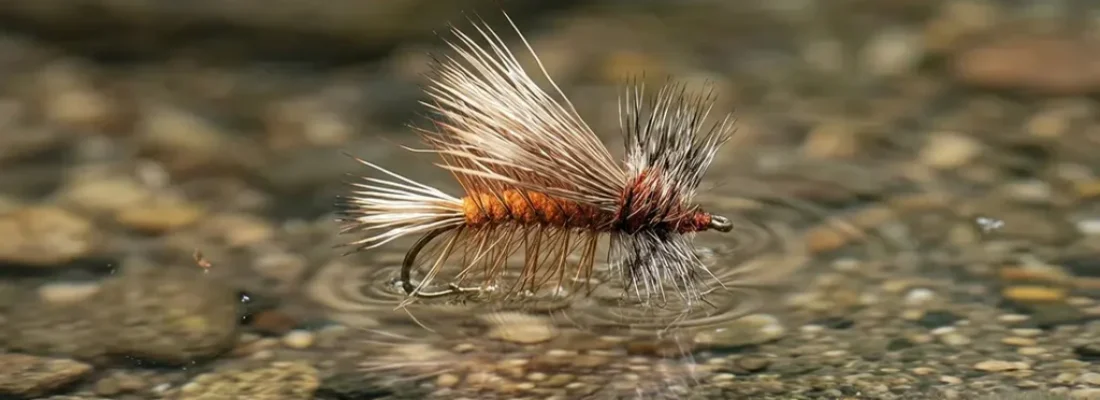
Kaufmann didn’t refine the Bird’s Stone. He took the elk hair logic that Barnes and Bird had proven and built something new from it — a fly so versatile that it matches salmonflies in size 4, golden stoneflies in size 8, and caddis in size 14 depending on what color you put on the hook. He called it the Stimulator and it became the most widely used stonefly dry fly in the American West almost immediately, which is either a testament to the pattern or an indication that western fly fishers are always looking for one fly that does everything.
It is a testament to the pattern.
This is Article 2 of Montana’s Classic Stonefly Bench. If you haven’t read Article 1 covering the Improved Sofa Pillow and the original Bird’s Stonefly, start there — it’s where this series and this hatch both begin.
Table of Contents
What Changed and Reason It Mattered
The original Bird’s Stonefly was built for utility. Three elk hair segments, palmered hackle, flat down wing — it worked because it was honest about the shape of the bug and fast to produce in volume. What it wasn’t built for was the kind of sustained scrutiny a heavily pressured fishery like the Henry’s Fork applies to every fly that comes over a fish.
On the Henry’s Fork, trout have seen everything. They have opinions about elk hair diameter, about hackle fiber length, about whether the wing profile matches the natural’s tent-shaped resting position. This is not hyperbole. Anyone who has fished Last Chance in July and watched a twenty-inch rainbow refuse a fly that caught twelve fish on the Madison two weeks earlier understands exactly what the Henry’s Fork does to patterns that are merely good enough.
The Improved Bird’s Stone addressed durability and profile simultaneously. The Stimulator addressed versatility — a fly that could move with the angler from river to river, hatch to hatch, without requiring a complete box change.
Both belong on your bench. They solve different problems.
How to Tie the Improved Bird’s Stone — Mike Lawson
Reason This Fly Exists
Mike Lawson refined the Bird’s Stonefly at Last Chance on the Henry’s Fork because the original, fished hard on demanding water, revealed structural weaknesses that casual fishing never exposes. The segmented elk hair abdomen loosened under repeated casting stress. The wing profile, acceptable on broken water, didn’t hold up under the low-angle scrutiny of spring creek fish feeding in slow, clear currents. Lawson tightened the construction at every binding point, reinforced the abdomen with a dubbed underbody, and improved the wing by selecting finer, more consistently textured elk hair that produced a cleaner downwing silhouette. The result is a harder-wearing, more precise version of Bird’s original that fishes everywhere the original does and performs better where the original struggles.
Hook & Materials
| Component | Material |
|---|---|
| Hook | Partridge K15DE or D4ef, size 4–10 |
| Thread | Semperfli Classic Waxed 6/0, orange |
| Tail | Elk hair, dyed orange, stacked |
| Underbody | Orange dubbing — angora or Sub Seal, Monster Bush Fur, sparse |
| Abdomen | Orange elk hair, three bound segments over dubbed underbody |
| Abdomen Hackle | Ewing Brown dry fly hackle, palmered through abdomen |
| Wing | Fine natural elk hair, stacked, tied flat and low |
| Thorax | Orange dubbing, fuller than abdomen |
| Thorax Hackle | Ewing dry fly hackle, 3–4 turns |
| Head | Orange thread |
The key difference from Bird’s original: The dubbed underbody beneath the elk hair segments is what separates this pattern from its predecessor. It stabilizes the abdomen segments, prevents slippage under fishing pressure, and gives the body a slightly fuller, more consistent profile that reads better in clear, slow water.
Tying Instructions
Step 1 — Hook and Thread Base
Mount a Partridge K15DE in the vise, size 4 or 6 for salmonfly hatches. Lay a smooth orange thread base from the eye to a point directly above the barb. No gaps — the thread base and the dubbed underbody that follows are the structural foundation the rest of the fly depends on.
Step 2 — Tail
Stack a moderate clump of dyed orange elk hair until tips are perfectly aligned. Length equal to the hook shank. Tie in with progressive-tension wraps — three soft turns, then tighten incrementally. The tail should point straight back with a slight natural splay. Trim butts at a taper, cover with thread.
Step 3 — Dubbed Underbody
This is the step that distinguishes the Improved Bird’s Stone from the original. Spin a sparse amount of orange angora or Haretron dubbing on the thread and wrap forward from the tail tie-in point to the two-thirds mark on the shank. Keep it sparse — this is an underbody, not a finished abdomen. The dubbing creates a foundation that the elk hair segments bind against firmly and stay bound against.
Step 4 — Hackle
Tie in a brown dry fly hackle by the tip at the base of the tail. Strip the base fibers, bind flat along the shank. This will be palmered forward over the dubbed underbody and elk hair segments.
Step 5 — Abdomen Segments
Cut three equal clumps of dyed orange elk hair, underfur removed. The clumps should be slightly smaller in diameter than those used for Bird’s original — finer fiber produces tighter, more controlled segments over the dubbed underbody.
First segment: Tie in at the tail base, tips rearward. Bind firmly at the one-third point, pulling the segment slightly forward to create a rounded lobe. The dubbing beneath gives you something to bind against — use it.
Second segment: Tie directly in front of the first, bind at the two-thirds point.
Third segment: Tie in front of the second, bind just short of the two-thirds mark. The three segments should sit tightly against each other with no gaps. The dubbed underbody will show at each binding point, creating a subtle segmentation effect that the original’s bare hook shank didn’t produce.
Step 6 — Palmer the Hackle
Wind the brown hackle forward through the three abdomen segments in five to six evenly spaced turns. The tighter segment construction of this pattern allows slightly more hackle turns than the original without crowding. Tie off at the front of the abdomen, trim the tip cleanly. Trim hackle fibers below the hook shank.
Step 7 — Wing
Select fine-grade natural elk hair — finer fiber than the abdomen material produces a cleaner, more compressed downwing silhouette. Stack until tips are perfectly even. The wing extends to the tip of the tail. Tie in directly in front of the abdomen with firm pinch wraps, keeping the wing low and flat over the body. This is not a high-wing pattern. The wing lies on the body like the natural’s folded wings lie on the naturals. Trim butts, cover with thread.
Step 8 — Thorax
Dub a fuller thorax than Bird’s original used — orange angora or Haretron built into a distinct hump in front of the wing. Two to three full turns of dubbing. The thorax is visible from below the surface and contributes to the fly’s overall profile in a way that Bird’s sparse original thorax didn’t.
Step 9 — Thorax Hackle
Tie in a brown dry fly hackle in front of the thorax. Three to four full turns forward — fuller than Bird’s original front hackle. This is a Henry’s Fork fish. It needs to see something worth eating. Tie off behind the eye, sweep fibers rearward, hold with thread pressure.
Step 10 — Head and Finish
Small, clean orange thread head. Whip finish twice. Hard head cement, fully cured before fishing.
Tying Notes
The dubbed underbody is the heart of this pattern and the step most tiers skip because it seems like extra work. It is not extra work. It is the difference between a fly that fishes three days and one that fishes three weeks. Tie a dozen of each version and fish them side by side on demanding water. You will not skip the underbody again.
Carry in sizes 4, 6, and 8. The size 8 on fine tippet fishes the latter stages of the salmonfly hatch on pressured water when the size 4 is getting refused by fish that have been eating naturals for two weeks and know the difference between elk hair and the real thing.
How to Tie the Kaufmann Stimulator — Randall Kaufmann
Reason This Fly Exists
Randall Kaufmann built the Stimulator in the 1980s to solve a problem that tiers who fish multiple western rivers encounter every season: the hatch calendar keeps moving and the box doesn’t always keep up. The Stimulator is tied in salmonfly colors for the late May Madison, in golden stone colors for the July Gallatin, in olive and yellow for late-season stoneflies on smaller streams, and in smaller sizes as a caddis attractor on rivers where the salmonfly hatch is a rumor rather than a reality. One tying method, one fundamental construction logic, infinite seasonal application.
What makes it work on a technical level is the divided wing and the dubbed thorax hackle — both lifted from Atlantic salmon tying traditions and applied to a western stonefly problem. The divided elk hair wing creates a profile that catches light differently than a flat downwing, producing a more complex silhouette that reads as a different, arguably more realistic insect from below. The dubbed thorax with hackle through it adds bulk and movement that a thread-built thorax simply doesn’t deliver.
Hook & Materials
| Component | Material |
|---|---|
| Hook | Partridge, 3X long, size 2–16 |
| Thread | Semperfli , orange (salmonfly version) |
| Tail | Elk hair, dyed orange or gold depending on version |
| Abdomen | Orange Antron or Monster Bush Fur dubbing |
| Abdomen Hackle | Ewing Brown or grizzly saddle hackle, palmered |
| Wing | Natural elk hair, tied upright and divided |
| Thorax | Orange Antron or Monster Bush Fur dubbing, full |
| Thorax Hackle | Grizzly Dry fly hackle, palmered through thorax |
| Head | Orange thread |
Hook note: The Partridge is the correct hook for this pattern. Its 3X long shank and curved design support the body profile the Stimulator requires. Substituting a standard dry fly hook changes the silhouette in ways that matter on demanding water.
Color variations:
- Salmonfly version: Orange abdomen, brown abdomen hackle, orange wing, orange thorax, grizzly thorax hackle
- Golden stone version: Yellow or gold abdomen, brown abdomen hackle, natural elk wing, yellow thorax, grizzly thorax hackle
- Olive version: Olive abdomen, brown abdomen hackle, natural elk wing, olive thorax, grizzly thorax hackle
Tying Instructions
Step 1 — Hook and Thread Base
Mount a Partridge Hook K15DE in the vise, size 4 or 6 for the salmonfly version. The K15DE curved shank is part of the design — don’t fight the hook’s geometry, work with it. Lay orange thread from the eye to a point above the barb.
Step 2 — Tail
Stack a moderate clump of dyed orange elk hair, tips aligned. Length equal to half the hook shank. Tie in at the bend with progressive tension — the tail should splay slightly and naturally. This is a Stimulator and it doesn’t need a perfectly rigid tail. Trim butts, cover with thread.
Step 3 — Abdomen Hackle
Tie in a brown or grizzly saddle hackle by the tip at the tail tie-in point. The hackle fiber length should equal approximately 1.5 times the hook gap. Strip the base and bind flat. This gets palmered forward over the dubbed abdomen.
Step 4 — Dubbed Abdomen
Spin orange Antron or Haretron dubbing on the thread — enough to build a full, slightly tapered abdomen. This is not a sparse underbody. The dubbed abdomen is the visual core of the fly and it should be proportionally substantial without being fat. Wrap forward from the tail tie-in to the halfway point on the shank in touching turns.
Step 5 — Palmer the Abdomen Hackle
Wind the abdomen hackle forward through the dubbed body in evenly spaced turns — four to five wraps across the abdomen. Tie off at the front of the abdomen. The hackle should sweep rearward naturally over the dubbed body. Trim fibers below the hook shank.
Step 6 — Wing
This is the step that distinguishes the Stimulator from every other elk hair stonefly pattern. Cut and stack a substantial clump of natural elk hair — proportionally larger than on the Bird’s Stone or Sofa Pillow. Stack until tips are dead even.
Tie the wing in directly in front of the abdomen, but angle it slightly upright rather than completely flat — roughly 30 to 45 degrees above the hook shank. Then divide it into two equal sections using figure-eight thread wraps between the sections. The divided upright wing is the Stimulator’s signature profile feature. It catches light, creates movement, and produces a silhouette that no flat downwing pattern replicates.
Trim butts at a taper and cover with thread.
Step 7 — Thorax Dubbing
Dub a full, generous thorax of orange Antron or Haretron in front of the wing. This thorax is substantially fuller than the abdomen — it should look like the natural’s swollen thorax section when viewed from the side. Three to four full turns of well-loaded dubbing. The thorax hackle gets palmered through this dubbing, so it needs to be substantial enough to support that hackle without collapsing.
Step 8 — Thorax Hackle
Tie in a grizzly saddle hackle in front of the wing, immediately ahead of the thorax dubbing. Palmer it forward through the dubbed thorax in three to four tight turns. Tie off behind the eye. The grizzly thorax hackle through the orange dubbing creates a color interaction — barred brown and grey over orange — that is more visually complex than a solid-colored hackle and produces movement in the water that fish respond to even on slow, flat surfaces.
Step 9 — Head and Finish
Build a small, clean thread head. Whip finish twice. Hard head cement. The Stimulator’s construction at the eye is compressed — multiple components converge here — so a clean, tight head matters more on this pattern than on simpler flies.
Tying Notes
The Stimulator is deceptively simple to tie at the recipe level and genuinely difficult to tie well at the execution level. The divided wing requires practice to produce consistently — the figure-eight wraps must be firm enough to hold division while the hackles and dubbing that follow are being applied. Tie twenty before you decide whether you’re doing it right.
Carry the salmonfly version in sizes 2, 4, and 6. Carry the golden stone version in sizes 6 and 8. Carry the olive version in sizes 8 through 12 for late-season use. The Stimulator is not a fly you carry one size of. Its value is in its range.
Improved Bird’s Stone vs. Stimulator: The Practical Difference
Both flies work on the salmonfly hatch. Both are in production boxes across Montana. Here is when each earns its place on the end of your leader:
The Improved Bird’s Stone is the precision instrument. It has a lower profile, a more compressed silhouette, and performs better on educated fish in clear water — the Henry’s Fork, the spring creek sections of the Madison, slow tailwater pools where fish are rising selectively and have time to examine what’s floating over them. When the hatch has been on for two weeks and the fish have seen ten thousand elk hair stoneflies, reach for the Improved Bird’s Stone in a size smaller than you think you need.
The Stimulator is the confidence fly. It floats higher, casts a more complex silhouette, and triggers aggressive takes from fish that are actively feeding rather than selectively rising. It is the right call on the broken water of the upper Gallatin, the pocket water sections of Rock Creek, and any situation where you need a fly you can see and fish you can locate before they locate you. It is also the pattern you tie on when the hatch is just beginning and the fish haven’t yet developed the opinions that two weeks of naturals will give them.
Fish both. Switch when one stops working rather than waiting to understand exactly why it stopped working. The fish will teach you the distinction faster than any article can.
What’s Next in the Series
Montana’s Classic Stonefly Bench moves into golden stonefly and early-season Skwala territory in Article 3. If the salmonfly hatch is the event that defines May and June on Montana’s big rivers, the golden stonefly is the quieter, longer-running hatch that serious anglers build their July around — and the Skwala is what gets you out of the house in March when the rivers are still cold and everyone else is still dreaming about the season instead of fishing it.
The bench has more to say. Come back for it.
← Article 1: The Improved Sofa Pillow & Bird’s Stonefly Article 3: The Golden Stone & Skwala
Montana’s Classic Stonefly Bench is an ongoing series covering the foundational western dry fly patterns from the tiers who built them.