Description
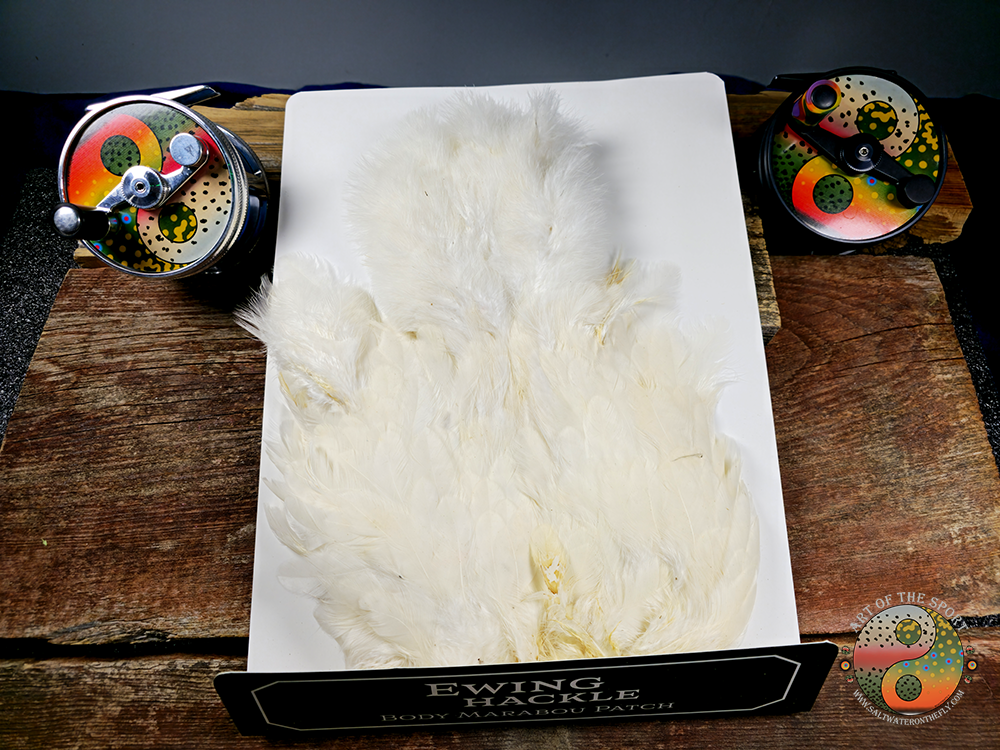
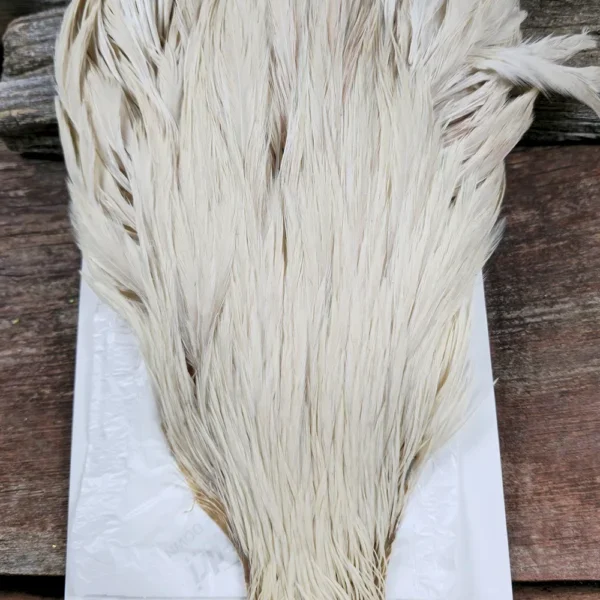
White Ewing Chickabou Marabou for Baitfish Flies
White is the baitfish color. Shad, shiners, mullet, glass minnows, alewives, sardines — the belly of almost every forage fish on earth is white, and predators key on that flash of belly when a baitfish turns.
White Ewing Chickabou gives you clean, bright marabou fibers that glow in murky water and read as “easy meal” in clear water. It’s also the most versatile patch on the bench: hit it with a Sharpie or a Copic marker and you can bar it, spot it, or tint the back any color you want.
Snook, stripers, redfish, pike, bass, crappie, trout. White works anywhere something eats minnows.
Recipe 1: White Chickabou Snook Seaducer
- Hook: Saltwater 1/0–2/0
- Thread: White 140-denier
- Tail: White Ewing Chickabou, two plumes, splayed slightly outward, plus 4 strands silver flash
- Body: White saddle hackle, palmered thick to the eye
- Collar: Red saddle, 2 turns (the “gill”)
- Weedguard (optional): 30-lb mono loop
Tying:
Splay the chickabou tail with a few thread wraps under it so it kicks out on the pause. Palmer the white saddle tight and dense; the fly should look like a fat hackle bottlebrush with a soft, swimming tail.
How to fish:
Work mangrove edges and dock lights. Cast tight to cover, let it sink a count of two, then strip 6 inches, pause, strip 6 inches. The Seaducer suspends and wobbles — snook eat it on the pause. Night fishing around lights is its best show.
Recipe 2: White Chickabou Crappie Jig
- Hook: 60-degree jig hook, #8–#10
- Head: 1/64–1/32 oz tungsten or lead jig head, painted pearl
- Thread: White 8/0
- Tail: White Ewing Chickabou, one plume, 1.5× shank length
- Body: Pearl Ice Dub, thin
- Collar: A few fibers of white chickabou wrapped as a hackle
Tying:
Tie the tail in heavy at the bend so it doesn’t wrap around the hook. Wrap one short chickabou collar behind the head for extra breathing.
How to fish:
Under a small indicator, set 2–4 feet deep around brush piles and docks in spring. Let it sit; the wind chop makes the chickabou swim on its own. Twitch it every few seconds. When the bobber stalls, set.
Recipe 3: White Chickabou Sugar Momma
The Sugar Momma is Kisha Atkin’s jigged streamer, built to fish deep holes on a tight line, and Saltwater on the sells it tied in white, tan, black and olive and other great colors. The magic is the chickabou collar. White is the original color, so this one is the closest to Kisha’s fly — with Ewing Chickabou in the collar.
- Hook: Partridge Ideal jig hook, #8
- Bead: 3/16″ (4.6 mm) slotted tungsten, copper or silver
- Thread: White Semperfli Nano Silk, 50-denier
- Flash: Silver Semperfli Ice Dubbing fibers, Angel Hair or Ice Wing
- Wing: Two white hen saddle feathers
- Spreader: Natures Spirit Predator Dub, Unicorn White
- Hackle: Natural mallard flank
- Collar: White Ewing Chickabou, spun in a dubbing loop
Tying:
- Slide the bead on, set the hook in the vise, and lay a thread base from behind the bead back to above the hook point.
- One eye-length behind the bead, tie in a thin bundle of flash by its middle. Fold the front half back, wrap back over it to the hook point, and trim the ends ragged at 2 to 2.5 inches.
- Match two narrow hen saddles by their tips and size them to about 2 inches. Tie one flat against each side of the shank, curves facing in, so they sit parallel.
- Bring the thread forward. Comb a pinch of Laser Dub into a flat, even bundle, center it on top of the shank, take two loose turns, then cinch it so it wraps all the way around.
- Fold the front fibers back, build a small thread dam to hold them, and brush the spreader even.
- Tie in a mallard flank feather with 1 to 1.5-inch fibers by its tip. Take three or four turns up toward the bead, tie off and trim.
- Build a 4-inch dubbing loop right behind the bead. Fold one or two chickabou plumes in a Petitjean Magic Tool or a feather prepper, clip the fibers, cut off the stems, and lay them in the loop. Spin it into a stemless brush.
- Wrap the brush tight up to the bead, tie off and whip-finish. Brush the fibers up and back so the head flares wide.
How to fish:
Kisha fishes it on a tight-line rig in deep holes. Work it with small jerks and twitches, like a baitfish having a bad day. The jig hook rides point-up, so you can bounce it on the bottom without hanging up. On a streamer rod, use a short sink-tip and the same twitch-and-pause retrieve.
Reviews
There are no reviews yet.