
Description
Natural Mallard Spey Feathers
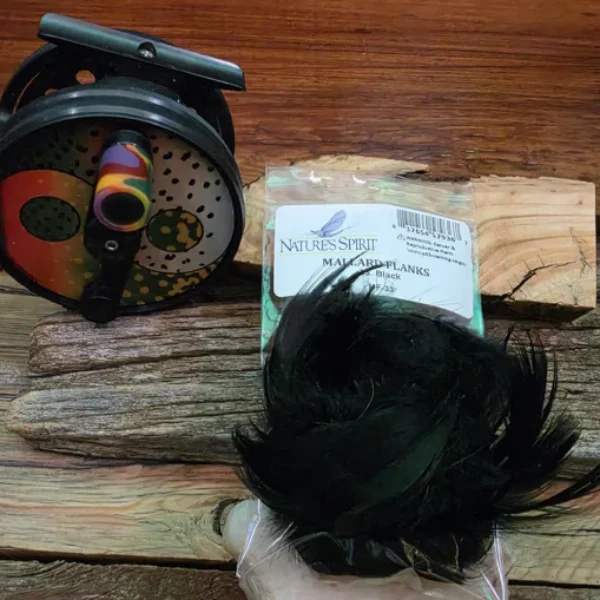
No dye, no tricks. Natural mallard flank has the crisp black-and-grey barring that every fish-catching spey fly borrows from, and it’s the one material in this category you’ll go through fastest.
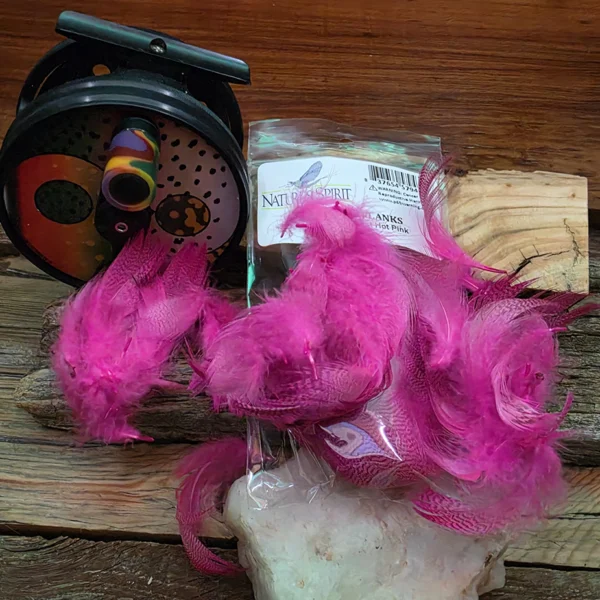
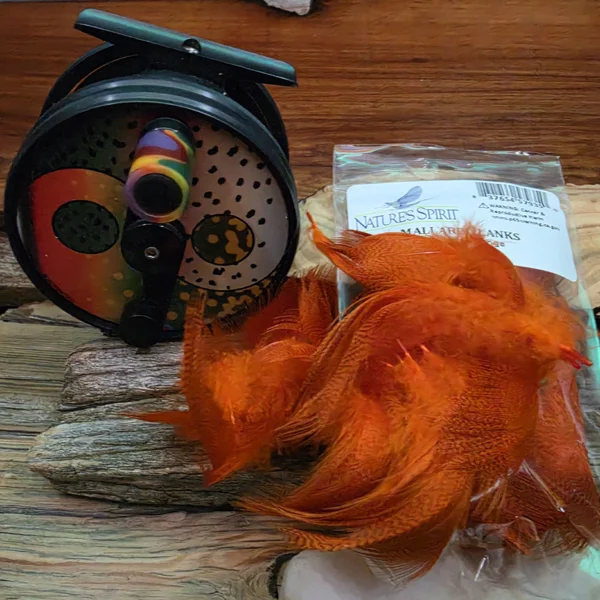
Twelve jumbo natural mallard spey feathers per pack, hand-picked for steelhead and salmon tiers. These are the long, symmetrical feathers you want for tented wings, full wrapped collars and sparse throats. The barring gives the fly segmentation and life that synthetics still can’t fake.
Buy two. You’ll use them.
Recipe 1: Grumpy’s Barred Spey
- Hook: Size 1/0 to 4 Alec Jackson spey hook
- Thread: Black 8/0
- Tag: Flat silver tinsel
- Body: Rear half orange floss, front half black SLF dubbing
- Rib: Oval silver tinsel
- Hackle: Black schlappen through the dubbed section
- Collar: Two turns of Natural Mallard Spey
- Wing: Matched strips of Natural Mallard Spey, tented low over the body
- Head: Black
How to fish it: My everyday spey fly for summer and fall steelhead. Fish it on a floating line or light sink tip in riffles and walking-speed runs. Cast, mend once, then leave it alone. The barred collar does all the work. Cover the run top to bottom and move on.
Recipe 2: Mallard-Collared Sculpin Swinger
- Hook: Size 2 to 4 trailer hook on a 35 to 45 mm shank
- Thread: Olive or tan 140 denier
- Tail: Tan rabbit strip, about 1.5 inches
- Body: Olive-brown Ice Dub
- Rear collar: Natural Mallard Spey, two turns
- Head: Spun or stacked olive and tan deer hair, trimmed flat, or a sculpin helmet
- Front collar: One more turn of Natural Mallard Spey behind the head
- Eyes: Small lead dumbbell, tied on top so it rides hook-point up
How to fish it:
Sculpins live on the bottom, so fish this one deep. Use a Skagit head with a T-11 or T-14 tip. Swing it slow along the bottom through soft edges and boulder gardens. Steelhead, big browns and bull trout all eat it. Give it a twitch or two on the hang; sculpins dart.




Reviews
There are no reviews yet.