
Description
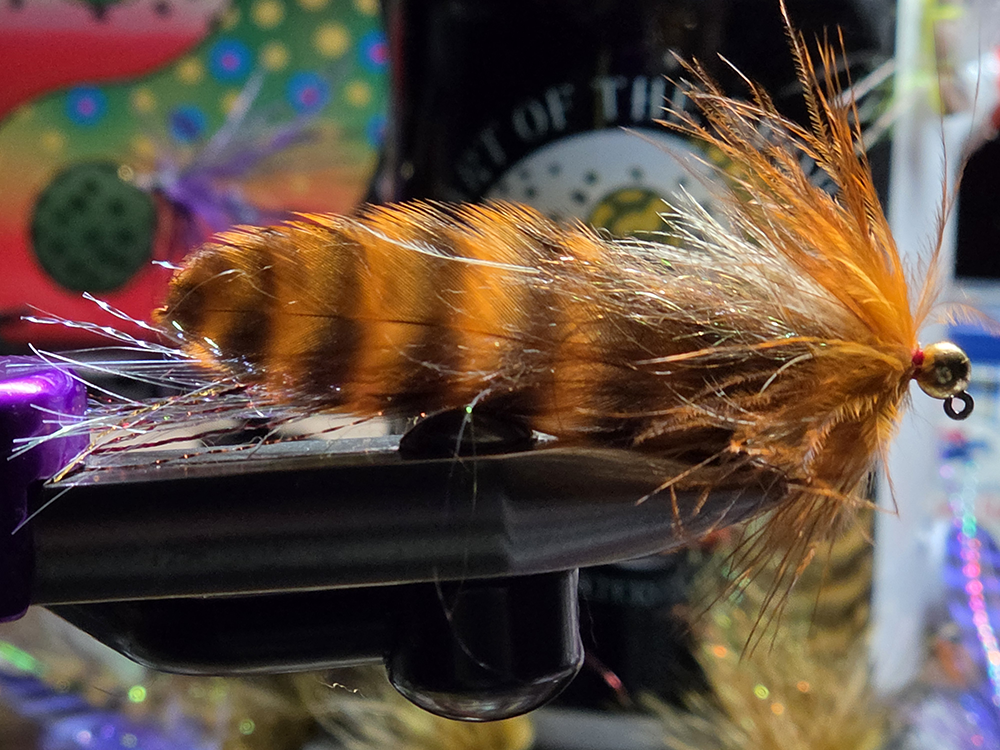
Orange Grizzly Ewing Chickabou Marabou Body Patch
Orange Grizzly is bright orange with black bars. It’s the orange belly of a fall brook trout, the tiger stripes on a firetiger lure, and the barred fins of a perch. Predators that eat other fish notice it fast.
Orange Grizzly Ewing Chickabou gives you barred orange fibers for muskie and pike accents, brook trout streamers, and steelhead hot spots. It’s loud but natural — a hard combination to find.
Muskie, pike, brown trout, bull trout, steelhead and smallmouth.
Recipe 1: Orange Grizzly Chickabou Firetiger Muskie Fly
- Hook: Two 4/0 saltwater hooks, articulated with 60-lb wire
- Thread: Chartreuse 210-denier
- Rear section: Chartreuse bucktail, Orange Grizzly Ewing Chickabou on the bottom, plus gold flash
- Front section: Chartreuse and yellow bucktail, black marker bars
- Throat: Orange Grizzly chickabou, two full plumes
- Head: Chartreuse EP fiber or bucktail, large 3D eyes
Tying: Firetiger is chartreuse on top, orange underneath, black bars. The orange grizzly chickabou gives you the orange belly and barring in one material that moves.
How to fish: In stained water in fall, use a sinking line and strip it back with long pulls. At the boat, finish with a figure-eight. Many muskie eat in the figure-eight. Always finish every cast with one.
Recipe 2: Orange Grizzly Chickabou Little Brook Trout Streamer
- Hook: 4XL streamer, #4–#6
- Thread: Black 6/0
- Tail: Green bucktail, short, with a few fibers of Orange Grizzly Ewing Chickabou
- Body: Cream dubbing, ribbed with flat silver tinsel
- Throat: Orange Grizzly chickabou, a full tuft
- Wing: Olive-green chickabou with a few black fibers on top (the vermiculations)
Tying: This is a soft chickabou version of the classic Little Brook Trout bucktail. The orange grizzly throat copies the bright orange fins of a spawning brookie.
How to fish: Big brown trout eat young brook trout in fall. Fish it on a sink-tip near deep banks and logjams. Strip it in short, quick pulses. Expect a heavy hit.
Recipe 3: Orange Grizzly Chickabou Sugar Momma
The Sugar Momma is Kisha Atkin’s jigged streamer, sold by Umpqua in white, tan, black and olive. This is my hot version for steelhead and fall browns: a ginger body with a barred orange collar that looks like a brook trout’s fins.
- Hook: Partridge Ideal jig hook, #8 (go to #6 for steelhead)
- Bead: 3/16″ (4.6 mm) slotted tungsten, copper or gold
- Thread: Orange or tan Semperfli Nano Silk, 50-denier
- Flash: Gold or copper Angel Hair or Ice Wing
- Wing: Two ginger or tan hen saddle feathers
- Spreader: Natures Spirit Predator Dub, orange or gold
- Hackle: Natural mallard flank, or wood-duck-dyed mallard
- Collar: Orange Grizzly Ewing Chickabou, spun in a dubbing loop
Tying:
- Slide the bead on, set the hook in the vise, and lay a thread base from behind the bead back to above the hook point.
- One eye-length behind the bead, tie in a thin bundle of flash by its middle. Fold the front half back, wrap back over it, and trim the ends ragged at 2 to 2.5 inches.
- Match two narrow hen saddles by their tips, size them to about 2 inches, and tie one flat against each side, curves facing in.
- Bring the thread forward. Comb a pinch of Natures Spirit Predator Dub into a flat bundle, center it on top of the shank, take two loose turns, then cinch it so it wraps around the shank.
- Fold the front fibers back, add a small thread dam, and brush the spreader even.
- Tie in a mallard flank feather by its tip and take three or four turns up toward the bead. Tie off and trim.
- Build a 4-inch dubbing loop behind the bead. Fold one or two Orange Grizzly chickabou plumes in a Magic Tool or feather prepper, clip the fibers, cut off the stems, and lay them in the loop. Spin it into a brush.
- Wrap the brush tight to the bead, tie off, whip-finish, and brush the fibers up and back.
How to fish: For steelhead, swing it on a sink-tip through soft tailouts and give it a twitch at the end of the swing. For fall browns, tight-line it through deep runs below riffles with short jerks and pauses. The orange barring shows in stained water when plain colors disappear.


Reviews
There are no reviews yet.