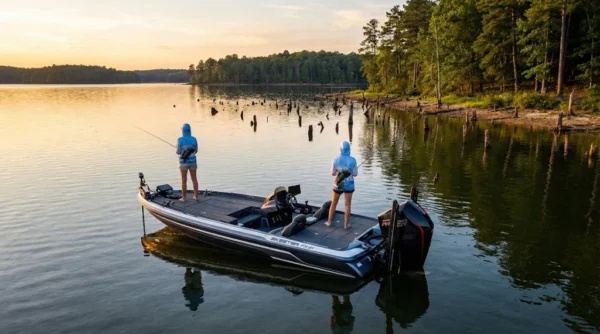
West Point Lake Fly Fishing: Georgia’s Chattahoochee Bass and Hybrid Striper Lake
West Point Lake sits on the Chattahoochee River on the Georgia-Alabama border south of Atlanta, a 25,900-acre reservoir that does not get the fly fishing attention its fishery warrants. West Point Lake fly fishing is built on a hybrid striped bass program that is among the most productive in Georgia, a largemouth bass fishery that benefits from the Chattahoochee’s productivity and the lake’s diverse habitat, and a spotted bass population in the rocky, current-influenced upper lake sections that gives fly fishers a species option that most reservoir anglers in the region overlook entirely. West Point is close to Atlanta, consistently productive, and almost never mentioned in fly fishing conversations. That is an opportunity.
Hybrid striped bass — wipers — are West Point Lake fly fishing’s most dynamic target and the fish that most thoroughly rewards the fly rod approach. West Point’s wiper population is supported by annual stocking and the lake’s exceptional threadfin shad forage base, producing aggressive fish that regularly push into double-digit weights and feed on the surface with a violence that makes every other form of freshwater fly fishing seem reserved by comparison. West Point wiper surface feeding activity peaks in spring — April through June — when fish chase shad schools into the warming shallows and create surface blitzes in the creek arm mouths and along the main lake’s transition zones. Fall produces a second major surface feeding window from September through November as wipers push shad against the surface in the main lake’s open water ahead of the cooling season. Large white Deceivers, popping bugs, and shad-pattern streamers fished into breaking fish is West Point Lake wiper fly fishing at its most straightforward and its most exciting.
Largemouth bass fly fishing on West Point Lake follows the Chattahoochee River impoundment pattern that applies throughout this river system — creek arm structure dominates the productive bass habitat, with the Wehadkee Creek arm, Stroud Creek, and the numerous feeder drainages along the Georgia eastern shoreline providing the flooded timber, vegetation, and gradual depth transitions that largemouth spawn in and use throughout the summer. Spring bass on West Point begin moving shallow early given the lake’s southerly Georgia location — February can produce staging fish in warm years, with the main spawn running through April and into May in protected coves.
Spotted bass are West Point Lake’s underappreciated fly rod option, concentrated in the Chattahoochee River arm at the upper end of the reservoir where current, rocky bottom, and clear water create the habitat that spotted bass prefer over the softer, more vegetated conditions of the main lake. West Point spotted bass on crayfish patterns and small streamers fished in the river current of the upper arm fish more like river smallmouth than traditional reservoir bass, and that distinction makes them one of the more technically interesting fly rod targets the lake offers.
West Point Lake is a manageable size for a day trip from Atlanta and receives less weekend pressure than Lake Lanier to the north. The Georgia side of the lake, with the West Point Dam tailrace access and the state-managed boat ramps along the eastern shoreline, provides the best fly fishing access.
Target Species: Hybrid Striped Bass, Largemouth Bass, Spotted Bass, White Bass, Crappie, Catfish Best Seasons: April–June (wiper surface, bass spawn) | September–November (fall wiper, bass) Fly Patterns: Large Deceivers, poppers, shad streamers, Clousers, crayfish patterns Notable Areas: Chattahoochee River arm, Wehadkee Creek, Stroud Creek, West Point Dam tailrace, main lake open water, Georgia eastern shoreline