Montana’s Classic Stonefly Bench: Colorado — Cheesman Canyon, the Frying Pan, the Roaring Fork, and the Arkansas
Series: Montana’s Classic Stonefly Bench — Article 7
Colorado trout went to graduate school.
This is not an opinion. It is the conclusion of every angler who has stood in Cheesman Canyon on the South Platte staring at a twenty-inch brown trout feeding six inches below the surface on something too small to see, presented four different flies on 7X tippet, watched the fish refuse all of them without accelerating its heart rate, and driven back to Denver with the distinct sensation that the river has a PhD and you have a library card.
Colorado fly fishing is beautiful, technically demanding, frequently humbling, and occasionally transcendent in ways that no other western state quite replicates. The Frying Pan below Ruedi Reservoir is fourteen miles of Gold Medal water where rainbow trout grow to ten pounds on mysis shrimp pumped directly from the dam and then develop opinions about everything a fly fisherman subsequently tries to feed them. The Roaring Fork through Basalt and Carbondale is blue ribbon freestone water with a stonefly calendar that runs from the Skwala in early spring through golden stones in July and little yellow stones into August. The Arkansas from its headwaters near Leadville down through Salida and on to Cañon City covers more varied river character in a single drainage than most states manage across their entire trout water inventory.
I have spent days of genuine splendor on all of it. Cheesman Canyon on the South Platte down through the Deckers stretch. The Frying Pan. The Roaring Fork. The headwaters of the Arkansas in the high country above Leadville where the river is narrow enough to jump across and the cutthroat don’t yet know that fly fishers exist. These are not casual day trips. They are destinations that deserve full attention and return multiple times on the attention invested.
This is Article 7 of Montana’s Classic Stonefly Bench. The series that started on Pat Barnes’ bench in West Yellowstone has crossed Wyoming and arrived in Colorado, where the rivers are colder, the fish are smarter, the hatch charts are more complicated, and the drive back to the truck takes longer than you planned because nothing in Colorado is as close as the map suggests.
You already know everything that will happen. Go anyway.
Table of Contents
Four Colorado Rivers, One Shared Requirement
The South Platte, the Frying Pan, the Roaring Fork, and the Arkansas are different rivers with different characters, different fish, and different demands. What they share is the requirement that you be better than you were on the last river you fished.
The South Platte through Cheesman Canyon and Deckers:
is Colorado’s proving ground. The canyon section is two miles of some of the most demanding dry fly water in North America — clear, cold tailwater flowing through a granite gorge where the fish hold in spring creek-style lies and inspect every fly with the deliberate calm of something that has never had a bad day and intends to keep it that way. The Deckers stretch below the canyon opens the river into more accessible water — riffles, runs, gravel bars, classic pocket water — while retaining the South Platte’s fundamental character of highly educated fish in crystal-clear water. This is not a river that rewards impatience. It rewards stealth, precision, fine tippet, and the willingness to change flies before you’ve convinced yourself the current pattern is working.
Flows between 150 and 400 cfs are the Deckers sweet spot. Below that the fish can count your boot studs. Above it you’re nymphing in a freight train. Check the Denver Water gauge before you make the drive. The South Platte’s flows are dam-controlled and they change on a schedule that does not consult your fishing plans.
The Frying Pan:
is fourteen miles of Gold Medal tailwater between Ruedi Dam and the Roaring Fork confluence at Basalt. The mysis shrimp flushed from the deep water of Ruedi Reservoir fatten the Pan’s brown and rainbow trout to sizes that seem implausible for a river this small — fish over ten pounds exist in the upper sections. These are also the most selective trout per mile of any river covered in this series, which makes the mysis shrimp’s role both a blessing and a curse. The trout are enormous because the food supply is extraordinary. They are also almost impossible to fool because the food supply has given them options and options produce preferences and preferences produce refusals. The stonefly hatches on the Pan run from salmonflies in May through little yellow stones in August, and the fish that respond to a stonefly dry during an active hatch are your best opportunity of the day. Find the hatch. Fish to actively rising fish. Everything else on the Frying Pan is an exercise in humility.
The Roaring Fork:
from its headwaters above Aspen through Carbondale to the Colorado River confluence is the most varied of Colorado’s four great rivers — freestone in character through much of its length, with the stonefly calendar running nearly as long as the Montana rivers that started this series. The Skwala hatch in March and April, golden stones in July, little yellow stones through August. The Roaring Fork through the Snowmass Canyon section and the public water between Basalt and Carbondale is where serious Colorado anglers spend their July — lower pressure than the Pan, more varied water, and golden stone and yellow sally hatches that produce aggressive surface feeding from brown and rainbow trout that haven’t spent their entire lives being presented size 22 midge patterns by Front Range day-trippers.
The Arkansas River:
headwaters begin above Leadville at over 10,000 feet elevation and drop through Salida, through the Royal Gorge, and into Cañon City — a single river covering freestone headwaters, gold medal tailwater, and one of the most dramatic canyon sections in Colorado. The upper Arkansas above Buena Vista is freestone water with cutthroat and brown trout that eat attractor dries without philosophical debate. The gold medal water from Salida to Cañon City holds brown trout that match anything on the South Platte for size and selectivity. The stonefly hatch calendar runs from golden stones in June through yellow sallies in August, and the Arkansas in July is one of the most underrated dry fly rivers in the state.
Colorado Stonefly Calendar
| Hatch | River | Timing | Size |
|---|---|---|---|
| Skwala | Roaring Fork, Frying Pan | March–April | 8–12 |
| Salmonfly | Frying Pan, Arkansas | May–early June | 4–8 |
| Golden Stonefly | All four rivers | June–July | 6–10 |
| Little Yellow Stone | All four rivers | July–August | 12–16 |
| Yellow Sally | Roaring Fork, Arkansas, Eagle | June–August | 14–16 |
Colorado altitude note: Every row in this table shifts later at higher elevation. The Roaring Fork above Aspen runs two to three weeks behind the lower valley. The Arkansas headwaters above Leadville can push golden stone timing into August. Altitude moves the calendar more reliably than any other variable on Colorado water. If you’re planning a trip around a specific hatch, know the elevation of the water you’re fishing and adjust accordingly.
How to Tie the Colorado Girdle Bug
Reason This Fly Exists
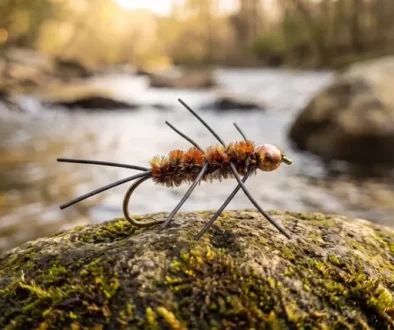
The Girdle Bug is the South Platte’s foundational stonefly nymph and one of the most important flies in Colorado fly fishing history. It predates the rubber leg revolution, it predates the tungsten bead era, and it predates most of what passes for innovation in contemporary nymph tying — and it still outfishes half the flies tied since it was invented because it does something that more complicated patterns occasionally forget to do: it gets to the bottom and stays there while looking vaguely alive.
The original Girdle Bug was nothing more than black chenille and white rubber legs on a long shank hook, heavily weighted with lead wire. No bead, no dubbing, no wingcase, no taper. Just mass and movement and a silhouette that stonefly nymphs produce from below in moving water. Cheesman Canyon fish ate it then. Cheesman Canyon fish eat it now. The pattern has survived sixty years of tactical evolution in the Colorado fly tying world because the fish never read the memo about sophistication.
The version in this article adds a tungsten bead, a sparse peacock herl thorax, and barred rubber legs in brown rather than the original white — refinements that improve both the fly’s appearance and its rate of descent without compromising the fundamental simplicity that made the original work.
Hook & Materials
| Component | Material |
|---|---|
| Hook | Partridge D4AF, 4X long nymph, size 6–12 |
| Thread | Semperfli Classic 6/0, black |
| Bead | Black tungsten, sized to hook |
| Weight | Lead wire, 12–15 wraps |
| Tail | Black rubber legs, two strands, tied in a V |
| Body | Black medium chenille |
| Legs | Brown barred rubber legs, two pairs |
| Thorax | Peacock herl, 3–4 strands twisted |
| Head | Black thread behind tungsten bead |
Weight note: The South Platte through Cheesman Canyon runs cold and clear over a rocky bottom with complex currents that push a lightweight nymph out of the strike zone immediately. Weight this fly heavier than instinct suggests. A Girdle Bug that never reaches the bottom where the fish are is a very expensive drift.
Rubber leg note: The legs are the heartbeat of this fly. In the slow, clear pools of Cheesman Canyon the rubber legs pulse with every micro-current variation — in water where the trout can see everything, movement is the trigger that static patterns cannot provide. Use good quality barred rubber legs and don’t trim them too short. The length creates the movement.
Colorado Girdle Bug Tying Instructions
Step 1 — Bead, Hook, and Thread Base
Slide a black tungsten bead onto a Partridge D4AF size 8 and mount in the vise. Wrap 12 to 15 turns of lead wire behind the bead and push snug. Start black thread and build smooth transition ramps over the lead, covering from the lead front to the lead rear. The body chenille binds best against a covered lead underbody.
Step 2 — Tail
Cut two strands of black rubber leg material approximately one hook-gap length each. Tie them in at the bend in a V configuration — one strand slightly to each side, tips pointing rearward and slightly outward. The tail is spare and functional — this is not a flashy pattern and the tail should not be.
Step 3 — Body Chenille
Tie in black medium chenille at the tail tie-in point. Wrap forward in tight, touching turns to the two-thirds mark. The chenille should be dense and even — each wrap touching the previous one with no hook shank showing. Tie off, trim. The Girdle Bug body is black and it should be convincingly, completely black from every angle.
Step 4 — First Leg Pair
Using figure-eight wraps, tie one pair of brown barred rubber legs at the front of the chenille body — one leg on each side, splaying outward and slightly rearward. First pair done.
Step 5 — Second Leg Pair
Advance thread slightly toward the bead. Tie in the second pair of rubber legs using the same figure-eight technique. This second pair sits just behind the bead and is slightly shorter than the first — the two pairs at different positions create a more complex, multi-legged profile than a single pair provides.
Step 6 — Peacock Herl Thorax
Twist three to four strands of peacock herl into a rope on the thread. Wrap two to three turns of the twisted herl between the second leg pair and the bead. The peacock herl thorax adds a subtle iridescence between the two leg pairs that a solid black thorax doesn’t produce — in the clear water of Cheesman Canyon that iridescence matters.
Step 7 — Head and Finish
Small black thread head tight behind the bead. Whip finish twice. Hard head cement. Apply a drop of UV resin over the peacock herl thorax and cure it — peacock herl frays quickly on rocky bottoms and a resin coat extends the fly’s productive life significantly.
Field Tips for the Colorado Girdle Bug
Cheesman Canyon: Fish the Girdle Bug as the point fly in a two-nymph rig — Girdle Bug on the bottom, size 18 Pheasant Tail or RS2 on a 16-inch dropper above it. The Girdle Bug carries the rig to the bottom and attracts attention; the smaller nymph closes the deal on fish that follow the big fly and don’t commit. Set depth at one and a half times the water depth. In the slower pools of Cheesman Canyon that means a long indicator setup that feels wrong until you start catching fish.
Reading Deckers: The Deckers stretch rewards anglers who fish the transitional water — the seam between fast riffle and slower run, the tailout of each pool where nymphs concentrate before emergence, the pocket water behind boulders where food accumulates. Don’t pound the obvious flat-water lies that everyone else is fishing. Find the transitions and work them systematically.
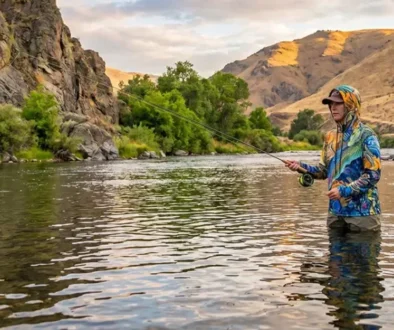
Stealth above everything: The South Platte through Cheesman and Deckers is glass-clear water and the fish can see you before they can see your fly. Approach from downstream, stay low, keep your shadow off the water, and wear fish camo clothing. A brown trout that has spotted you is not a brown trout that will eat your fly. This is not a suggestion. It is the fundamental rule of South Platte fishing and it cannot be overcome by changing patterns.
How to Tie the Frying Pan Salmonfly Special
Reason This Fly Exists
The Frying Pan salmonfly hatch starts in early May and lasts two to three weeks — a concentrated window on a river full of enormous, food-obsessed trout that have spent the rest of the year eating mysis shrimp and midges and are presented in May with something the size of a small bird falling off the streamside willows. The response is not subtle.
The Frying Pan Salmonfly Special is not a complicated fly. It is a size 4 or 6 foam-bodied, rubber-legged stonefly dry that floats all day without dressing, lands with the authority of a real insect, and triggers the kind of aggressive surface take from a ten-pound Frying Pan rainbow that you spend the rest of the season trying to replicate on smaller fish with smaller patterns and finding, consistently, that nothing quite matches it.
The construction is identical to the Deschutes Canyon Stone from Article 4 — foam underbody, orange dubbed abdomen, rubber legs, flat elk hair wing, brown front hackle. What changes is the application: this fly fishes the Frying Pan’s specific character, which means accurate placement to the narrow feeding lanes in the upper section’s flat pools and a drag-free drift that lasts longer than any other river in this series demands.
Hook & Materials
Tie this pattern using the identical construction as the Deschutes Canyon Stone from Article 4.
| Component | Material |
|---|---|
| Hook | Partridge, size 4–6 |
| Thread | Semperfli 6/0 Classic, orange |
| Tail | Dark moose body hair |
| Underbody | Orange closed-cell foam |
| Abdomen | Orange Antron dubbing over foam |
| Abdomen Hackle | Dark brown saddle, palmered |
| Rubber Legs | Brown barred rubber legs |
| Wing | Natural elk hair, flat and low |
| Thorax | Orange dubbing |
| Head Hackle | Brown dry fly hackle |
For the full tying sequence, refer to Article 4: The Deschutes and the Rogue.
Frying Pan-Specific Field Notes
The upper Pan — Toilet Bowl to the Flats: The first two miles below Ruedi Dam are the most technically demanding water on the river. The Toilet Bowl — a deep, slow pool immediately below the dam — holds fish so large and so pressured that they have developed opinions about fly line weight. Fish this section on a 12-foot leader minimum, 4X tippet for the salmonfly pattern, and approach every pod of rising fish from downstream with the patience of someone who has nothing else to do today. Because you don’t. The Frying Pan requires your entire attention.
The middle Pan — miles 2 through 8: The river develops character as it moves downstream from the dam — riffles, pocket water, runs with actual current. The stonefly patterns fish more naturally here than in the upper flats. Standard 9-foot, 3X leader. More active feeding fish, less slow-water scrutiny. This is where days of splendor actually happen.
Drag is your enemy: The Frying Pan’s feeding lanes in the flat upper sections are narrow and complex — multiple current speeds crossing each other in ways that produce immediate micro-drag on any fly that isn’t perfectly presented. The fish eat the fly that doesn’t drag. Every other fly in the history of the river is irrelevant. Mend aggressively, use a reach cast, and shorten the drift before the drag starts rather than mending after it has already cost you the fish.
How to Tie the Amy’s Ant — Colorado’s Stonefly Attractor
Reas0n This Fly Exists
The Amy’s Ant was developed on Colorado’s freestone rivers — specifically the Arkansas and its tributaries — as an answer to a question that serious Colorado anglers spend considerable time with: what do you fish on a river that has stoneflies hatching, hoppers coming off the banks, and caddis on the surface simultaneously, and the fish appear to be eating all three without committing to any one of them?
The Amy’s Ant is the answer. It is a foam-bodied, rubber-legged, orange-butted attractor that reads as a stonefly to the fish that want a stonefly, as a hopper to the fish that want a hopper, and as a large terrestrial to every other fish in the river that is simply willing to eat something big and orange that lands near the bank. It is the right fly for the Arkansas headwaters above Leadville where the cutthroat eat everything. It is the right fly for the Roaring Fork in July when the golden stone hatch overlaps with hopper season. It is the right fly for any Colorado freestone river during midsummer when the surface feeding is active and the fish have not yet decided what they’re specifically after.
The old timers would have fished this fly. They would have caught fish on it, lost track of how many, and written something funny about the one that got away. That is the correct relationship to have with the Amy’s Ant.
Hook & Materials
| Component | Material |
|---|---|
| Hook | Partridge, size 6–10 |
| Thread | Semperfli 6/0 Classic, black |
| Tail/Butt | Orange closed-cell foam, small ball tied at bend |
| Body | Black closed-cell foam, 2mm, segmented |
| Body Hackle | Ewing Black dry fly hackle, palmered |
| Legs | Black barred rubber legs, two pairs |
| Wing | White poly yarn or EP Fibers, sparse |
| Head | Black foam pulled forward |
The orange butt: The orange foam ball at the bend is the Amy’s Ant’s signature feature and its most important functional component. In the multi-hatch confusion of Colorado midsummer, the orange butt provides the color trigger that stonefly patterns and hopper patterns share — orange is visible, it reads as biological rather than mechanical, and it catches the eye of a feeding fish that is scanning the surface for anything large and edible. Do not omit it. Do not substitute a different color. The orange butt is what makes this fly the Amy’s Ant rather than a generic foam attractor.
Tying Instructions
Step 1 — Hook and Thread Base
Mount a Tiemco 2302 size 8 in the vise. Black thread from eye to bend.
Step 2 — Orange Butt
Cut a small piece of orange 2mm closed-cell foam — approximately 4mm square. Fold it in half and tie it in at the very bend of the hook with several tight wraps. The folded foam should form a small, distinct orange ball at the bend. This is the butt and it should be compact, rounded, and visibly orange from every angle. Trim any excess foam that doesn’t contribute to the rounded profile.
Step 3 — Body Hackle
Tie in a black dry fly hackle by the tip directly in front of the orange butt. Bind flat to the shank.
Step 4 — Black Foam Body
Cut a strip of black 2mm foam approximately 4mm wide. Tie it in directly in front of the orange butt, binding it flat along the top of the hook shank. Advance the thread forward in three distinct sections, binding the foam down at each section to create a segmented body profile. The foam should compress at each binding point and expand between them — three distinct humps between the orange butt and the eye.
Step 5 — Palmer the Hackle
Wind the black hackle forward through the segmented foam body in four to five turns. Tie off at the front of the body, trim.
Step 6 — Rubber Legs
Tie one pair of black barred rubber legs on each side using figure-eight wraps — one pair near the rear of the body, one pair near the front. Legs splay outward and slightly downward.
Step 7 — Wing
Tie a sparse clump of white poly yarn or EP Fibers on top of the hook directly in front of the front leg pair. Divide into two equal posts with figure-eight wraps. The white wing is a visibility aid — it is how you track this fly on the choppy surface of the Arkansas at distance. Keep it sparse. A bulky wing adds wind resistance and reduces casting accuracy.
Step 8 — Foam Head
Pull the black foam strip forward over the wing tie-in and bind it down immediately in front of the wing, creating a distinct head. Trim the foam slightly past the eye of the hook and round the cut end with scissors. The foam head should extend slightly over the eye — this is the Amy’s Ant’s characteristic nose profile that makes it immediately recognizable on the water.
Step 9 — Head and Finish
Thread head behind the foam. Whip finish twice. UV resin on all foam binding points.
Field Tips for the Amy’s Ant
Arkansas headwaters above Leadville: Size 10, short stout leader, 3X tippet. Fish the bankside structure — the cutthroat in the upper Arkansas hold tight to any cover the river provides and will move several feet to eat an Amy’s Ant that lands near the bank. Keep moving upstream. The upper Arkansas rewards the angler who covers water over the angler who works one pool extensively.
Roaring Fork midsummer: Size 8 or 10 during the golden stone and hopper overlap period — late July through mid-August. Fish the grassy banks where hoppers fall in. The Amy’s Ant’s orange butt reads as the leg color of a large hopper or the abdomen of a golden stone, depending on which theory the fish has developed. In practice the fish does not explain its reasoning and you should not ask.
Arkansas gold medal water — Salida to Cañon City: More technical than the headwaters but less demanding than the South Platte. Size 10 Amy’s Ant as a hopper-dropper indicator with a size 16 Pheasant Tail or Hare’s Ear dropper. The big browns in the Royal Gorge section will follow the Amy’s Ant and ignore it — the dropper is what those fish eat. Use the surface fly as a strike indicator and let the nymph do the work.
Colorado Technical Fishing — The Rules Nobody Writes Down
Because six articles into this series you’ve earned the real information.
7X tippet is not excessive on the South Platte. The Cheesman Canyon fish can see 6X. They’ve been looking at 6X for years and they know what it means. Use fluorocarbon, use 7X, and tie your knots carefully because 7X with a bad knot is just 7X with a weak point in the middle of your leader.
The Frying Pan crowds thin beyond mile 2. The first two miles below Ruedi Dam are heavily pressured on weekends throughout the season. Walk past them. The middle river between miles 2 and 8 has the same fish density, more varied water, and dramatically fewer anglers. The fish haven’t read the guidebooks that say the upper section is the best section. They are distributed throughout the river.
The Arkansas above Buena Vista is underrated. The gold medal water from Salida to Cañon City gets most of the press and most of the pressure. The upper Arkansas above Buena Vista — the freestone headwater section — is quieter, less pressured, and full of brown and cutthroat trout that haven’t been introduced to the concept of 7X tippet. Size 10 attractor dries on 4X and a willingness to walk produce fish all day.
The Roaring Fork’s best public water is below Basalt. The famous water around Aspen and Woody Creek gets the pressure and the reputation. The public water between Basalt and Carbondale — accessible from Highway 82 and the Crystal River Road sections — holds the same quality fish with considerably fewer anglers. The stonefly hatch fishes here the same way it fishes everywhere else on the river. The parking situation is less fraught.
Match the stage, not just the insect. Colorado’s tailwater fish — particularly on the Frying Pan and the South Platte — respond to specific stages of each hatch: nymph, emerger, dun, spinner. Knowing a PMD is hatching is not enough information. Knowing whether the fish are eating nymphs, emergers, or adults is the information that determines whether you catch fish or watch them feed. Watch the fish, not just the hatch.
Drive time in Colorado always exceeds the map. The Frying Pan looks close to Aspen on the map. Aspen is close to nothing. The Arkansas above Leadville looks accessible from Denver. It is two and a half hours on a good day. The canyon roads are beautiful and slow and full of people who drove from Texas to look at the mountains. Add forty-five minutes to every Colorado drive time estimate and bring coffee.
What’s Next in the Series
Montana’s Classic Stonefly Bench has now covered Montana, Oregon, Utah, Idaho, Wyoming, and Colorado. Article 8 takes the series into the Pacific Northwest’s most iconic stonefly water — the Deschutes tributaries, the Yakima, and the lower Columbia system rivers where stonefly tradition and steelhead fishing converge in ways no other region of the American West replicates.
The series does not run out of water. The water runs the series.
← Article 6: Wyoming — Lost, Found & Catching Cutthroat Article 8: Pacific Northwest Stonefly Country — Coming Soon →
Montana’s Classic Stonefly Bench is an ongoing series covering the foundational western stonefly patterns from the tiers who built them.