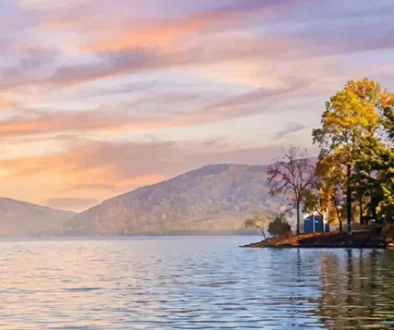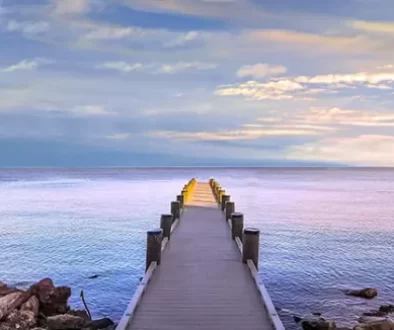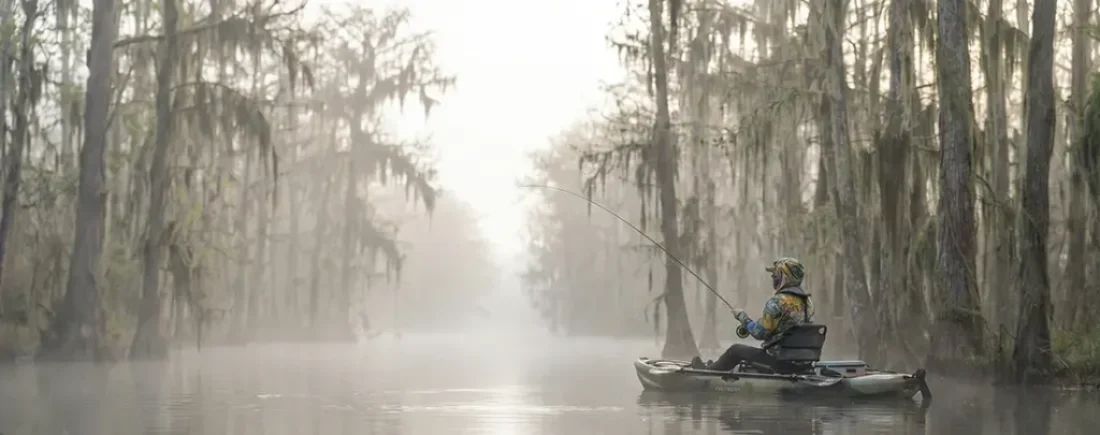
Lake Drummond What Is The Reason? (A Fair and Balanced Question) {#why-lake-drummond}
Let me be honest with you — and if you’ve been fly fishing long enough, you know that honesty is not the primary export of most fishing guides.
Lake Drummond is not Yellowstone. It is not the Gallatin River at dusk with a BWO hatch and a 20-inch brown sipping size-20s. There are no dry fly hatches to speak of. The water looks like cold black coffee that someone left on the counter in 1987. The surrounding swamp is home to black bears, cottonmouth moccasins, and approximately one trillion no-see-ums that apparently view human skin as fine dining.
And yet.
Lake Drummond is exactly the kind of place one out to blundered into while trying to find a gas station and ended up writing three chapters about. It is one of only two natural lakes in the entire state of Virginia. It sits dead center in the Great Dismal Swamp — a name so perfectly on-brand that it sounds like it was invented by a committee of pessimists — and it is one of the strangest, most atmospheric, most genuinely bizarre fly fishing destinations on the East Coast.
The fish here are not the glamour species. But they are characters. Bowfin that hit like a trailer hitch dropped from a second-floor window. Longnose gar that are essentially living fossils who’ve been waiting 100 million years for you to show up with a streamer. Chain pickerel with teeth like a broken bottle and absolutely no impulse control. Crappie stacked in the spring like commuters at a bus stop.
If you’re tired of the Instagram-filtered trout streams and want to fly fish somewhere that genuinely makes you feel like you’ve wandered off the edge of the map, Lake Drummond is your place.
Table of Contents
The Lay of the Land (and the Water, Which is Basically Tea) {#lay-of-the-land}
Lake Drummond covers roughly 3,142 acres and sits at the geographic heart of the Great Dismal Swamp National Wildlife Refuge, managed by the U.S. Fish and Wildlife Service. The refuge encompasses nearly 107,000 acres of forested wetlands — so yes, the lake is remote, and yes, if you wander off without a GPS, we will read about you in the newspaper.
The water is dark — deeply, magnificently, coffee-brown dark — because of the organic acids leaching from the peat soils that underlie the entire swamp. This is called tannic water, and it is both beautiful and ecologically important. The lake’s pH normally ranges from four to five, which is acidic enough to limit the types of fish that can survive here. Ironically, this same acidity is what kept this lake from being fished into oblivion. The species that do live here are the ones tough enough to handle it — and they are very tough.
The lake is remarkably shallow — maximum depth six feet, average depth three to four feet. That sounds like wading water, and in spots it practically is. It is also large and extremely dangerous in wind, because a six-foot lake with whitecaps on 3,000 acres is still 3,000 acres of problem. People have drowned here. Take that seriously.
Notable geography for fly fishing:
- Feeder Ditch (eastern access) — the narrow canal that connects the lake to the Dismal Swamp Canal. Three miles of atmospheric, tree-lined warmwater that fishes well for pickerel and crappie on its own.
- Vegetation edges — scattered aquatic vegetation around the shoreline is prime holding water for every species in the lake.
- Open bowl — the middle of the lake is largely open and featureless. Not usually the most productive water, but gar and bowfin cruise the shallows around it.
- Interior Ditch Road boat ramp (western access) — the drive-in option, and the quickest way to the open lake.