Oregon’s Stonefly Rivers
Montana’s Classic Stonefly Bench: The Deschutes and the Rogue — Oregon’s Stonefly Rivers
Series: Montana’s Classic Stonefly Bench — Article 4
The series started in Montana because Montana is where the tradition started. Pat Barnes in West Yellowstone. Cal Bird’s pattern working its way into guide boxes from the Gallatin to the Madison to the Clark Fork. The Improved Sofa Pillow, the Bird’s Stonefly, the Stimulator — all of them built for Montana water by people who fished Montana water and needed something better than what existed.
But the stonefly hatch doesn’t stop at the state line. Pteronarcys californica doesn’t check a map. The golden stone doesn’t care whether it’s hatching in Montana or Oregon. And the angler serious enough to follow the stonefly season west eventually ends up in Oregon — on the Deschutes, on the Metolius, on the Rogue — fishing the same fundamental insects on water with its own character, its own history, and its own patterns built by tiers who understood what their rivers required.
I made the drive from Salem more than once. A long weekend pointing the truck toward Sisters and the Metolius, then north to Maupin and the lower Deschutes canyon. Two rivers that fish nothing like each other and nothing like Montana, which is exactly why they’re worth the drive.
The Metolius comes out of the ground cold and clear at the base of Black Butte — a spring creek from its first moment, demanding in the way spring creeks are always demanding, rewarding in the way they rarely are. You nymph it with heavy rigs through pocket water that the indicator can’t follow correctly, and when the stoneflies and salmon flies come off in sizes 8 and 10 the dry fly fishing in the first eleven miles below the springs will remind you why you drove from Salem in the first place. The rattlesnakes on the basalt above Maupin are a different kind of reminder — to watch where you step, to pay attention to what you’re walking through, to stay present on water that is beautiful enough to make you careless if you let it.
Crane Prairie Reservoir and the upper Deschutes add another dimension entirely — stillwater and headwater fishing that most anglers who come to Oregon for the salmonfly hatch never bother with because Maupin is calling and the hatch is on. Their loss.
This is Article 4 of Montana’s Classic Stonefly Bench. The series has moved west and it’s not moving back. Two Oregon rivers, two distinct stonefly cultures, and the patterns that define both.
Table of Contents
Two Rivers, Two Personalities
Understanding the Deschutes and the Rogue means understanding that they share a state and a species list and almost nothing else.
The Deschutes:
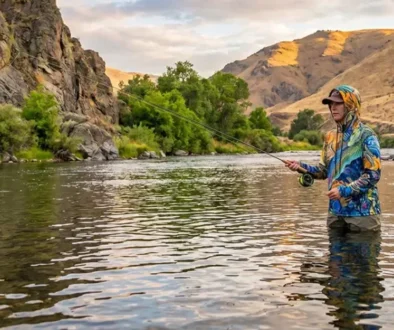
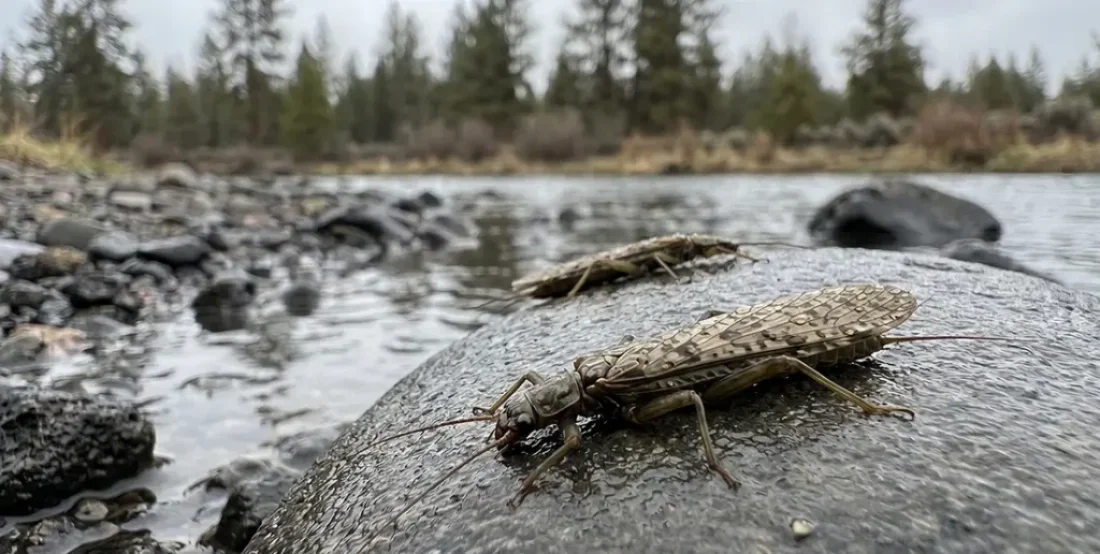
is a big desert tailwater — cold, powerful, and running through a basalt canyon that looks like it was designed by someone who wanted fly fishers to appreciate the difficulty of the access. The canyon section below Pelton Dam is the classic destination, the water below Trout Creek wild and scenic and 35 miles through country where there’s one way in and it’s downhill in a drift boat. The salmonfly hatch here is legendary not because it’s subtle but because it isn’t — every year, like clockwork, the grasses, trees, and bushes along the river start crawling with millions of stoneflies, and monster trout hide beneath tree branches along the banks, waiting for them to drop onto the water. Maupin gets crowded. The water below Trout Creek gets less so. Follow the pressure gradient downstream and you will consistently fish better water.
The salmonfly hatch usually starts downstream and pushes upriver about 2 to 5 miles per day — use timing to pick your zone, not habit. The trigger is water temperature, not a date on a calendar. When river temperatures reach 54 to 58 degrees Fahrenheit, the hatch begins. Warm weather can accelerate it; cooler water from Pelton Dam releases can delay it. Watch the gauges, not the calendar.
The Rogue:
is something else entirely. It starts near Crater Lake and runs 215 miles to the Pacific at Gold Beach, dropping through canyon sections of serious whitewater and past towns that have been fishing the same runs for generations. The upper river above Lost Creek Dam is classic freestone rainbow and cutthroat water — dry fly fishing on a 4-weight that rewards a patient approach and punishes a sloppy cast. The lower canyon is summer steelhead country where the stonefly patterns that work for trout also work, in larger sizes, swung on a tight line through the classic runs. The Rogue doesn’t ask you to choose between trout fishing and steelhead fishing. It offers both, often on the same day, sometimes in the same run.
The North Umpqua and Rogue River also see strong salmonfly emergences during the same window as the Deschutes, with the Rogue’s lower canyon seeing October Caddis well into fall. That autumn caddis hatch — large orange caddisflies in size 6 and 8, emerging in the afternoons and evenings — extends the surface fishing season on the Rogue into October and produces some of the most aggressive dry fly takes of the year on water that has settled into its fall character.
The Oregon Stonefly Calendar
| Hatch | River | Timing | Size |
|---|---|---|---|
| Skwala | Deschutes, Metolius | March–April | 8–12 |
| Salmonfly | Deschutes (lower to upper) | Late April–early June | 4–8 |
| Salmonfly | Rogue | March–July | 4–8 |
| Golden Stone | Deschutes, Rogue, North Umpqua | June–early July | 6–10 |
| Little Yellow Stone | Metolius, Deschutes, Rogue | June–August | 12–16 |
| October Caddis | Rogue, Deschutes, Metolius | Mid-September–October | 6–8 |
The October Caddis entry is not a stonefly — but it belongs in this article because it is the pattern that keeps serious Oregon anglers on the water through October when everything else has shut down, it ties on the same logic as the stonefly dries in this series, and it fishes the same water with the same presentation. The Rogue in October with a size 8 orange Stimulator is not a different conversation from the Deschutes in May with a size 4 Sofa Pillow. It is the same conversation in a different season.
How to Tie the Deschutes Canyon Stone
Reason This Fly Exists
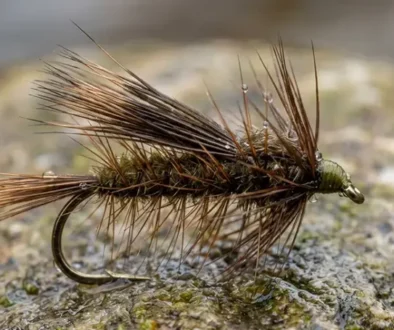
The Deschutes is a specific river with specific fish and specific fishing pressure, and the patterns that work best on it have been refined by guides and tiers who fish it daily during the hatch. The Deschutes Canyon Stone is the category of fly that serious Deschutes anglers reach for — a low-riding, foam-bodied or elk hair construction that sits in the surface film rather than on top of it, creating the sprawled, struggling profile of a salmonfly adult that has landed on the water and can’t get off.
The Deschutes fish are not naive. The river sees the most pressure it will see all year during the four-week hatch period, and the fish around Maupin and Warm Springs get wary. The pattern that works at the beginning of the hatch when the fish are fresh and aggressive is not always the pattern that works at the end of it when every fish in the accessible sections has seen ten thousand orange dries. Build your box with both ends of that spectrum in mind.
Hook & Materials
| Component | Material |
|---|---|
| Hook | Partridge Hook, size 4–8 |
| Thread | UTC 140, orange |
| Tail | Dark moose body hair or dark elk hair, stacked |
| Underbody | Orange closed-cell foam strip, trimmed to shank width |
| Abdomen | Orange Antron or Monster Bush Fur dubbing over foam underbody |
| Abdomen Hackle | Dark brown or furnace saddle hackle, palmered |
| Wing | Natural dark elk hair, tied flat and low |
| Legs | Barred rubber legs, two per side |
| Thorax | Orange dubbing, full |
| Head Hackle | Brown dry fly hackle, 2–3 turns |
| Head | Orange thread |
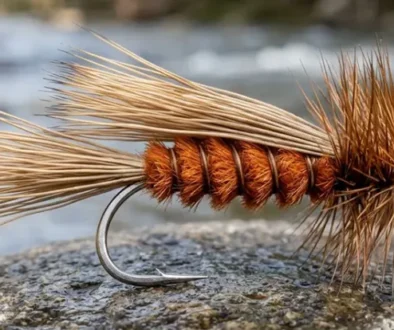
Reason to use foam: The foam underbody is the key adaptation for Deschutes fishing conditions. The canyon section runs big water — the kind of fast, deep current that swamps a purely elk hair construction after repeated casting. The foam underbody is unsinkable, keeps the fly riding correctly all day without dressing, and supports the profile of a large adult riding high enough to be visible in broken water without sitting so high that selective fish refuse it.
Rubber legs: The barred rubber legs are not decoration. Salmonfly adults are leggy, clumsy insects and the rubber legs create both the visual leg suggestion and a slight movement in the current that elk hair cannot replicate. On Deschutes fish that have seen elk hair stoneflies all week, the rubber leg movement triggers takes that static patterns don’t.
Tying Instructions
Step 1 — Hook and Thread Base
Mount a Partridge Hook size 4 or 6 in the vise. Orange thread from eye to bend, smooth and even.
Step 2 — Tail
Stack a small, sparse clump of dark moose body hair until tips are aligned. Moose body hair is stiffer than elk and sits more naturally upright as a tail on a larger hook. Length equal to half the shank. Tie in with progressive tension, trim butts, cover with thread.
Step 3 — Foam Underbody
Cut a strip of orange closed-cell foam approximately 3mm wide — slightly narrower than the hook shank. Tie in the foam strip at the tail tie-in point, binding it flat along the top of the hook shank. Do not stretch the foam while binding — tie it in relaxed. Wrap thread forward over the foam to the two-thirds mark, binding the foam flat against the shank the entire length of the abdomen. The foam should sit on top of the hook shank like a spine. Trim any excess foam forward of the abdomen.
Step 4 — Abdomen Hackle
Tie in a dark brown saddle hackle by the tip at the tail bind-in point. Strip the base, bind flat. This will be palmered forward over the foam and dubbing.
Step 5 — Dubbed Abdomen
Spin orange Antron or Haretron dubbing on the thread — enough to build a full abdomen over the foam underbody. The foam is already creating bulk so the dubbing layer is moderate rather than heavy. Wrap forward over the foam in touching turns to the two-thirds mark.
Step 6 — Palmer the Hackle
Wind the abdomen hackle forward through the dubbed body in four to five evenly spaced turns. Tie off at the front of the abdomen. Trim fibers below the hook shank.
Step 7 — Rubber Legs
Cut two pairs of barred rubber legs — brown and orange barring if available. Using figure-eight wraps, tie one pair of legs on each side of the hook directly in front of the abdomen. Each leg should extend approximately one hook-gap length beyond the hook on both sides. Pull the legs outward and slightly rearward — they should splay naturally and not point straight down.
Step 8 — Wing
Cut and stack a substantial clump of dark natural elk hair — darker fiber than the natural tan used on the Montana patterns in this series. The Deschutes canyon has a different visual character than the Madison and the wing color should reflect that. Stack until tips are even. Wing extends to the tail tip. Tie in flat and low directly in front of the rubber legs. The wing must stay flat — rubber legs and a wing that rises are two separate flies and you want the flat-winged downwing silhouette.
Step 9 — Thorax and Head Hackle
Dub a full orange thorax in front of the wing. Tie in a brown dry fly hackle, take two to three turns, sweep rearward, hold with thread pressure.
Step 10 — Head and Finish
Clean orange thread head, whip finish twice, hard head cement fully cured.
Tying Notes
Carry this pattern in sizes 4, 6, and 8. The size 4 is for the first week of the hatch on the lower canyon when the fish are aggressive and the adults are large. The size 6 covers the middle weeks. The size 8 is for pressured fish late in the hatch and for the canyon sections above Trout Creek where the hatch runs later and the fish are somewhat less educated.
Fish this pattern on 7.5 feet of 2X. The canyon wind will be in your face at some point during the day — a short, stout leader is not a compromise on the Deschutes, it is the correct tool.
How to Tie the Rogue River Stimulator
Reason This Fly Exists
The Rogue fishes differently than the Deschutes. It is a longer season, a more varied river, and it holds both resident trout and summer steelhead in the same runs. The pattern that serves the Rogue best is a Stimulator variant — the same Kaufmann construction covered in Articles 2 and 3, modified in size and color for the specific insects the Rogue produces across its long hatch calendar.
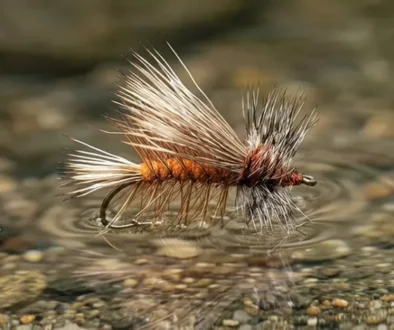
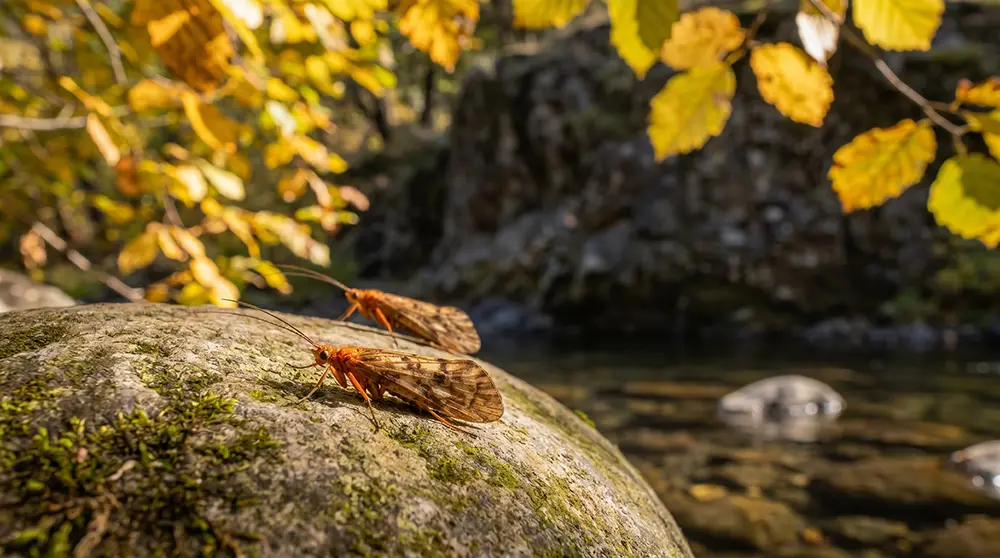
What distinguishes the Rogue Stimulator from the standard salmonfly version is primarily application: tied in size 4 and 6 orange for the spring salmonfly hatch, in size 6 and 8 gold for the golden stone, and in size 6 and 8 burnt orange for the October Caddis — a large orange caddisfly that hatches on the Rogue from mid-September through October and extends the surface season well past what most fly fishers plan for.
The October Caddis version deserves specific mention because it is the Rogue’s signature autumn hatch and it is tied on the same hook and with the same construction as the stonefly Stimulator, with burnt orange dubbing and an orange elk hair wing. The Rogue in October with this fly in the right run at the right time of afternoon is the kind of fishing that justifies the drive from anywhere.
Hook & Materials — Salmonfly Version
| Component | Material |
|---|---|
| Hook | Partridge Hook, size 4–6 |
| Thread | Semperfli Classic Waxed Thread, orange |
| Tail | Dyed orange elk hair |
| Abdomen | Orange Antron dubbing |
| Abdomen Hackle | Brown saddle hackle |
| Wing | Natural elk hair, upright and divided |
| Thorax | Orange Antron dubbing, full |
| Thorax Hackle | Grizzly saddle hackle |
| Head | Orange thread |
Hook & Materials — October Caddis Version
| Component | Material |
|---|---|
| Hook | Partridge Hook, size 6–8 |
| Thread | Semperfli 6/0 Classic Waxed Thread, burnt orange |
| Tail | Dyed orange elk hair, short |
| Abdomen | Burnt orange Antron dubbing |
| Abdomen Hackle | Brown saddle hackle |
| Wing | Natural elk hair or dyed orange elk hair, upright and divided |
| Thorax | Burnt orange Antron dubbing, full |
| Thorax Hackle | Brown saddle hackle |
| Head | Burnt orange thread |
Tying Instructions
Both versions of the Rogue River Stimulator are tied using the identical method as the Kaufmann Stimulator covered in detail in Article 2. The construction is unchanged — divided upright elk hair wing, dubbed abdomen with palmered hackle, full dubbed thorax with palmered grizzly or brown thorax hackle. The only variables are hook size, thread color, dubbing color, and tail color as specified in the materials tables above.
If you have not yet tied the Kaufmann Stimulator, read the full tying sequence in Article 2 before proceeding. The divided upright wing technique is the critical step and it is detailed there.
Tying Notes
Carry three versions on the Rogue: the orange salmonfly Stimulator in sizes 4 and 6 for the spring hatch, the golden Stimulator in sizes 6 and 8 for the midsummer golden stone, and the burnt orange October Caddis version in sizes 6 and 8 for the autumn hatch.
The October Caddis version is the one most tiers don’t have in their box when they need it. Tie a dozen before September and you will be better prepared than most of the anglers on the river with you.
For steelhead applications on the lower Rogue, upsize the Stimulator to a size 2 or 4 and fish it on a short, stout leader — 7.5 feet, 1X or 0X — swung through the classic runs rather than dead drifted. Summer steelhead will surface for a large orange dry fly presented correctly and the take is not something you forget.