Klamath River Chinook Are Back — And California Is Finally Opening the Gates
The ocean salmon season you’ve been waiting three years for is here. Don’t blow it.
If you’ve been sitting on your hands waiting for California’s ocean salmon season to come back to life, your patience just paid off. The California Department of Fish and Wildlife (CDFW) has confirmed that Klamath River fall-run Chinook — along with Sacramento River fall-run Chinook — have recovered enough that commercial fishing is back after a three-year closure and recreational anglers are looking at significantly more open days on the water in 2026.
I’ll say it plainly: this is big news. And it didn’t happen by accident.
Table of Contents
What Actually Happened to Klamath River Chinook?
Let’s not sugarcoat the recent history. The Klamath River fall-run Chinook got hammered. Years of drought, warming water temperatures, degraded habitat, and river conditions that were increasingly hostile to juvenile salmon survival drove populations into the kind of numbers that force hard decisions. In 2023 and 2024, California closed recreational ocean salmon seasons entirely. 2025 offered anglers exactly six days. Six.
That’s not a season. That’s a long weekend and a funeral.
The good news is that salmon are resilient when you give them half a chance — and a lot of people worked hard to give these fish that chance. State agencies, tribes, commercial fishing interests, NGOs, and sport anglers all had skin in the game. The dam removal on the Klamath, one of the largest dam removal projects in U.S. history, reopened hundreds of miles of spawning habitat. Habitat restoration, improved water flows, and better in-river management practices started moving the needle.
The fish noticed.
What the 2026 California Ocean Salmon Season Actually Means
The Pacific Fishery Management Council (PFMC) finalized its 2026 recommendations at its April meeting in Portland. Here’s what matters:
Commercial fishing is back. Three straight years of zero commercial ocean salmon fishing is over. That’s significant not just economically — it’s a signal that the science shows populations can sustain harvest pressure again.
Recreational anglers get more days. The CDFW will be implementing in-season management for both commercial and recreational fisheries, which means season dates, bag limits, and vessel limits will be actively monitored against harvest guidelines throughout the season. Seasons can close early if guidelines are hit — so pay attention.
In-season management is the new reality. 2026 marks the first year of vessel-based trip limits and seasonal harvest guidelines for the commercial fleet. This isn’t bureaucratic noise — it’s how you manage a recovering fishery responsibly. Stay plugged in to the CDFW Ocean Salmon Fishery Information page and the regulations hotline at (707) 576-3429 before every trip. The NMFS ocean salmon hotline at (800) 662-9825 will announce any in-season changes.
How to Fly Fish Klamath River Chinook — Locations, Spey Tactics, and Hard Lessons
If you’re reading this on a fly fishing site and wondering whether any of this applies to you, the answer is yes — emphatically, absolutely yes — and also, buckle up, because Chinook salmon on the fly will introduce you to a humility you didn’t know you were missing.
A mature Klamath fall-run Chinook runs anywhere from 20 to 40-plus pounds. They are not polite. They do not care about your casting stroke, your $900 spey rod, or the fact that you drove eleven hours from the Bay Area with your new wading boots still squeaking. They will take your carefully presented fly, turn downstream with the casual indifference of a freight train that didn’t notice a bicycle, and that will be the end of that relationship.
I’m not trying to scare you off. I’m trying to calibrate your expectations so you don’t show up thinking you’re going to replicate a Montana spring creek afternoon.
Where to Fish: Key Locations on the Klamath System
The Estuary and the Spit — Klamath, CA
This is where the river meets the Pacific, and it is, without argument, one of the most visually dramatic pieces of salmon water in the continental United States. The mouth of the Klamath at the sand spit near the town of Klamath is also where you’ll find the highest concentration of fellow anglers — which is either comforting or maddening depending on your disposition and how much elbow room you require to execute a proper Skagit cast. (Hint: more than most people give you.)
Fresh fish stack up in the tidal water here as they prepare for the push upriver. Swing big flies through the current seams on an incoming tide. This is meat-and-potatoes salmon fishing — no poetry, just results. Pay close attention to the spit closure regulations; this section can shut down fast once quotas are hit. Check before you drive. Then check again.
Orleans — The Heart of the Lower Klamath
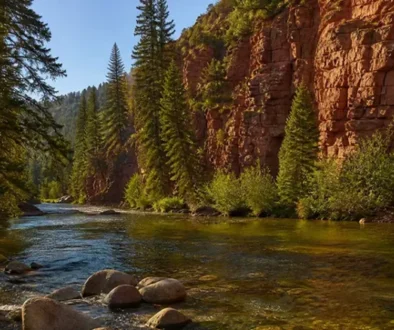
Orleans sits about 60 miles inland, and the Klamath here is a different river entirely — wide, powerful, tannin-stained in the fall, and surrounded by the kind of old-growth canyon scenery that makes you briefly reconsider every life choice that put you in an office. This is classic two-handed water. Long gravel bars, defined current seams, and fish that have been traveling long enough to be hungry, angry, or both.
The town of Orleans has a public access boat ramp and wade fishing along Highway 96 that will put you on good water without a guide — though I’d recommend hiring one your first time because the Klamath has approximately ten thousand ways to make a stranger look foolish.
Weitchpec — Where the Trinity Comes In
At Weitchpec, the Trinity River dumps into the Klamath, and the combined flow changes the character of the water dramatically. Fish from both drainages congregate here. It’s one of those spots where, if you’re standing in the right place at the right time, you feel like the smartest angler alive. Then the conditions change, the fish move, and you feel like the biggest fool in Humboldt County. Often within the same afternoon.
This is sacred water to the Yurok Tribe. Fish it with respect, follow tribal fishing area boundaries precisely, and understand that your inconvenience when a section is closed is genuinely not the most important consideration.
Happy Camp — Upper Lower Klamath
Further upstream, Happy Camp is where the river starts to narrow and the fish that have made it this far are legitimately impressive survivors. The crowds thin. The access requires more intention. The rewards scale accordingly. If you want elbow room on good salmon water in September, this is where you find it — after a drive on Highway 96 that will either relax you completely or make you regret every mile.
The Newly Opened Water — Post-Dam Removal
Here’s the section worth paying attention to for the next decade. The four dams — Iron Gate, Copco 1, Copco 2, and J.C. Boyle — are gone. The largest dam removal project in American history reopened over 420 miles of spawning and rearing habitat that anadromous fish hadn’t accessed in over a century. The fish are already exploring it. The regulations above the old Iron Gate dam site are still being figured out year by year — check current rules before you go anywhere near that water — but what’s coming is a Klamath River that nobody alive has ever fished at full potential.
That is not a small thing. I’d suggest getting familiar with this river now.
Spey Fishing Klamath Chinook: Techniques That Actually Work
Let’s talk two-handed rods, because on a river like the Klamath, a spey setup isn’t just showing off — it’s the practical tool for covering the wide, fast runs where Chinook hold, without wading in so deep that you audition for a Darwin Award.
The Setup
For Klamath Chinook, you want a 13- to 14-foot switch or full spey rod rated for an 8- or 9-weight Skagit head. If someone tries to sell you on going lighter, they either haven’t fought a fresh Klamath Chinook or they enjoy suffering more than I do. Running line should be something slick enough to shoot through the guides without argument. This is not the day for gear that requires patience.
Skagit heads in the 540–630 grain range, paired with T-14 or T-17 sink tips in 10- to 15-foot sections, will get your fly into the zone where Chinook actually hold — which is on or near the bottom, tucked behind current breaks, sheltered from the work of migration. They are not up top. They are not mid-column. They are down where the work is easy and your fly needs to go visit them.
The Casts
The beauty of Skagit casting for big salmon flies is its efficiency. You are not performing for an audience. You are getting a heavy, waterlogged fly into the water repeatedly, in confined canyon quarters, often with trees expressing opinions behind you.
- The Snap T is your workhorse for most Klamath situations. It’s fast, it rolls the head cleanly out of the water without a false cast, and it doesn’t require 40 feet of clearance behind you — which, on a river flanked by Douglas fir and alder, is not a trivial consideration. I once watched a man make seven consecutive false casts on the Klamath until a willow tree made the decision for him. He was a very good single-hand caster. He was not having a very good day.
- The Double Spey is your move when you have a downstream wind and enough room on your upstream step. It’s smoother, it loads the rod more elegantly, and it makes you look like you know what you’re doing. This is occasionally useful.
- The Perry Poke is what you reach for when the brush is genuinely impossible and you need to punt. It’s inelegant. It’s a little embarrassing. It works. Nobody who has fished enough canyons is above a Perry Poke.
The Swing
Swing flies through current seams at roughly a 45-degree angle downstream. Mend upstream after the cast to slow the fly through the strike zone — Chinook want the fly to move across them at a pace that suggests vulnerability, not desperation. If the fly is racing across the current like it has somewhere important to be, you’ve mended wrong. Slow it down.
Hold the fly at the end of the swing and let it hang for a full five count. A Chinook salmon will follow a fly for an unreasonable distance and then eat it on the dangle — which, for the uninitiated, is when the line is directly below you and the fly just sits there pulsing in the current. It feels too simple. It works embarrassingly often.
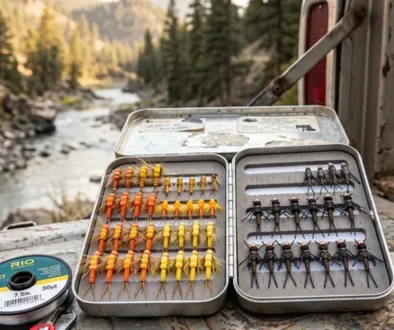
Flies for the Klamath
Go big. Go heavy. Go colorful enough that the fish notice and muted enough that they don’t panic.
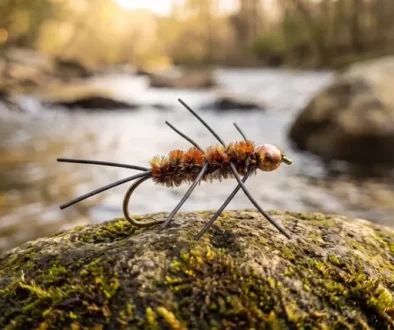
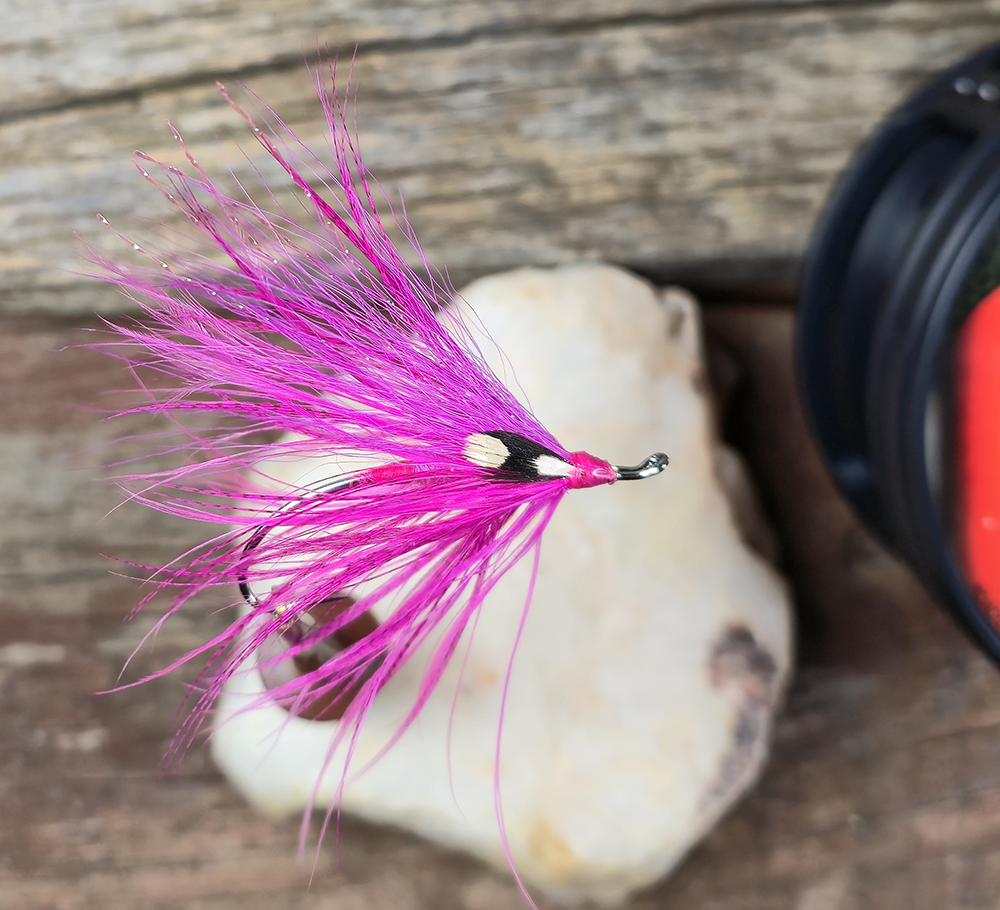
- Intruders in pink and black, orange and purple, chartreuse and white — 3 to 5 inches with heavy bead chain or conehead to keep them in the column
- Popsicles in cerise and orange
- Articulated baitfish patterns in chartreuse or white when fish are fresh from the ocean and still keyed on forage
- Egg-sucking leeches in black and red when fish are holding deeper in the run and need a little extra provocation
Don’t show up with a fly box full of size 12 elk hair caddis. I say this with love. The Klamath Chinook will not be impressed, and neither will anyone watching from the bank. Salmon-Steelhead Flies.
One Last Thing on Spey Tackle
Your spey rod will, at some point on the Klamath, load up on what you are certain is a 35-pound Chinook. The rod will bend. The reel will scream. You will feel briefly and completely alive in a way that most of adult life fails to provide.
And then the snag will release, your fly will come back, and you will stand there in a river canyon in Northern California with a look on your face that your friends will describe at dinner for the next three years.
This is part of the experience. Embrace it.
Don’t Get Sloppy — This Recovery Took Work
Here’s where I’ll get blunt, because someone has to say it.
This salmon recovery didn’t happen because we got lucky. It happened because a lot of people made sacrifices — commercial fishermen who lost three years of income, sport anglers who stayed off the water, tribes who fought hard for their fish, and restoration crews who did the unglamorous work of pulling out dams and replanting riparian corridors.
That history has a simple implication: fish within the rules, check the current regulations before you launch, and don’t be the guy who hammers a run that’s still finding its footing.
In-season management means the season can close if catch numbers run high. Know your bag limits. Know your vessel limits. Know whether the season is still open before you drive four hours to the coast.
Respect earned this recovery. Respect keeps it going.
The Bigger Picture on California Salmon
The CDFW and California Natural Resources Agency have California’s Salmon Strategy for a Hotter, Drier Future in active implementation. It’s not just a document that collects dust — habitat restoration projects are funded and in progress, barrier removal is ongoing, and water management practices are being modernized.
Will climate change continue to create pressure on salmon populations? Yes. Warming ocean conditions and drought cycles aren’t going away. But the trajectory on Klamath River Chinook is moving in the right direction, and that matters.
These fish are worth protecting. They’ve been a cornerstone of Northern California ecosystems and cultures for thousands of years. Getting them back isn’t just good for anglers — it’s good for everything that depends on a functioning river system.
Plan Your 2026 Klamath Salmon Trip
Before you go, bookmark these resources:
- CDFW Ocean Salmon Fishery Information Page – current season dates, harvest guidelines, gear restrictions
- CDFW Ocean Salmon Regulations Hotline: (707) 576-3429
- NMFS Ocean Salmon Hotline (in-season changes): (800) 662-9825
Check them before every trip. Not once at the start of the season — before every trip. That’s not paranoia. That’s how in-season management works.
The Klamath River Chinook are back. Now go fish responsibly, catch something worth bragging about, and don’t waste what took this long to rebuild. Learn More about Klamath River Steelhead Fly Fishing.
Capt. Grumpy covers fly fishing, saltwater fly fishing, and outdoor adventure at SaltwaterOnTheFly.com. If you’ve got questions about gear, tactics, or where to go, drop them in an email.