Shark Fly Fishing: A Gloriously Stupid Pursuit for People Who Think Trout Are Too Easy
Let’s be honest. At some point, standing knee-deep in a quiet river, gently presenting a size 18 dry fly to a selective brown trout stopped being enough. You needed more. More adrenaline. More teeth. More reasons to question your own sanity.
Enter shark fly fishing — the sport where you take a feathered hook, attach it to a long stick, and wave it at a creature that was already perfected by evolution 450 million years ago. Bold strategy.
Table of Contents
What Actually Happens Out There
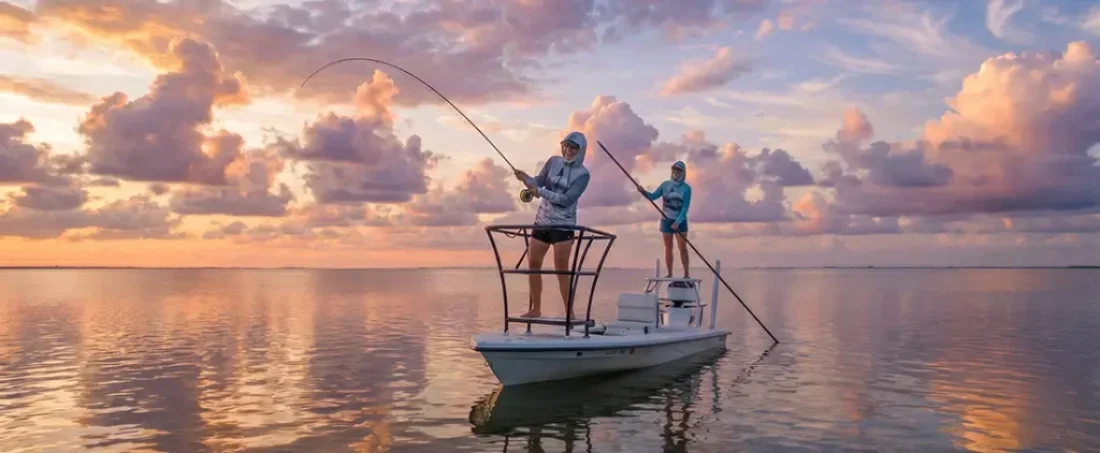
Picture it: You’re wading a sun-hammered flat somewhere in gin-clear water. The kind of place where you can see everything, which means everything can see you. Your guide whispers “shark, 11 o’clock, sixty feet.” Your hands do something involuntary. Your mouth goes dry.
You make the cast. It’s either the best cast of your life or a complete disaster — there’s no in-between when a hammerhead is your target. You strip the fly. The shark turns. And for about four seconds, time stops completely.
That’s the drug. That’s why people do this.
Landing one is pure controlled chaos — heavy leader, fast hands, a healthy respect for the fact that this fish could absolutely ruin your afternoon if it wanted to. Most of us aren’t Hemingway out there. We’re weekend warriors hoping to hook a memory and get home with the same number of fingers we left with.
The Gear That Actually Matters
Shark fly fishing is not the place to dust off your 5-weight. Leave that rod at home — it will not survive the conversation. Here’s what you actually need:
The Rod You’re throwing big flies on heavy rods, typically a 12 to 14-weight depending on target species. Blacktips and bonnetheads? A 10-weight can handle it. Bull sharks, hammerheads, lemons? Go heavier and don’t negotiate with yourself. A fast-action saltwater rod with a fighting butt is not optional — it’s how you stay in the fight long enough to matter.
The Reel Your drag needs to be smooth, strong, and completely reliable. This is the one place where “good enough” will absolutely get you broken off and humiliated. Look for a large-arbor saltwater reel with a sealed drag rated for serious heat. You’re not playing a 14-inch brown trout here. When a bull shark decides to leave the zip code, your reel is either going to perform or it’s going to give you a story you’re embarrassed to tell.
Line & Leader Shooting head or integrated saltwater taper — something that can turn over big flies in wind, because flats are windy and sharks don’t care about your casting conditions. Your leader setup is where things get serious. You need a shock tippet of either heavy monofilament (80–100 lb.) or single-strand wire, depending on what you’re targeting. Anything with serious teeth — bulls, hammerheads, tigers — wire is your friend. Skip it on bonnetheads and blacktips if you want to keep your sanity and still feel the take. Minimum 12 inches of shock material. More if you’re nervous. You should probably be a little nervous.
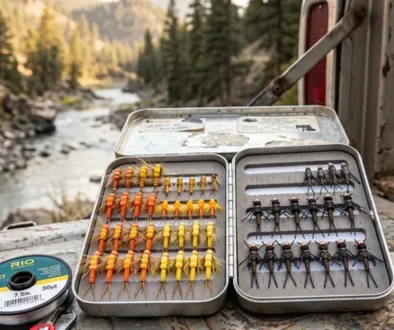
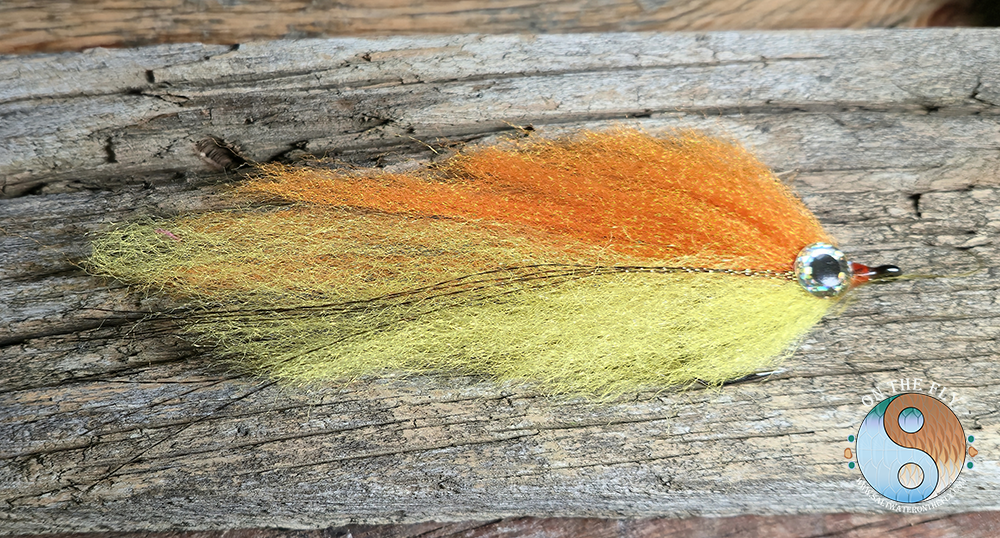
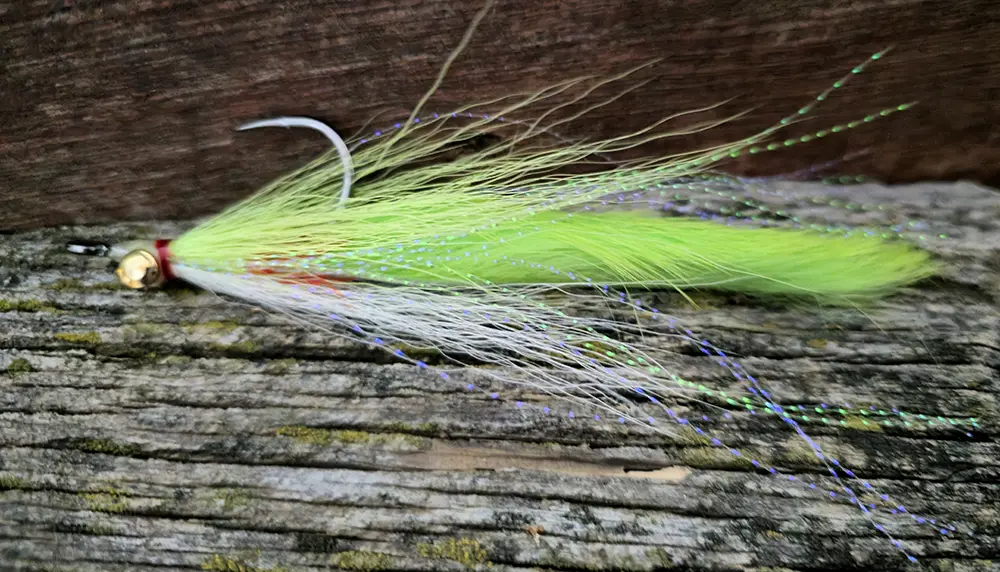
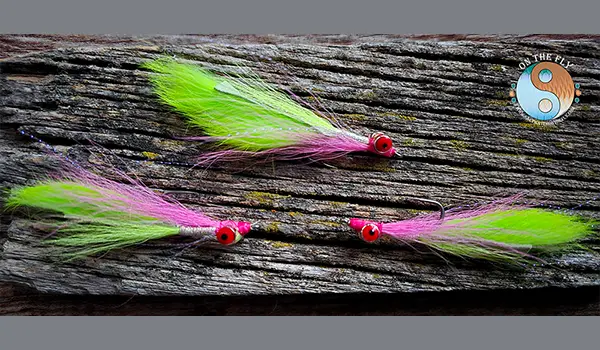
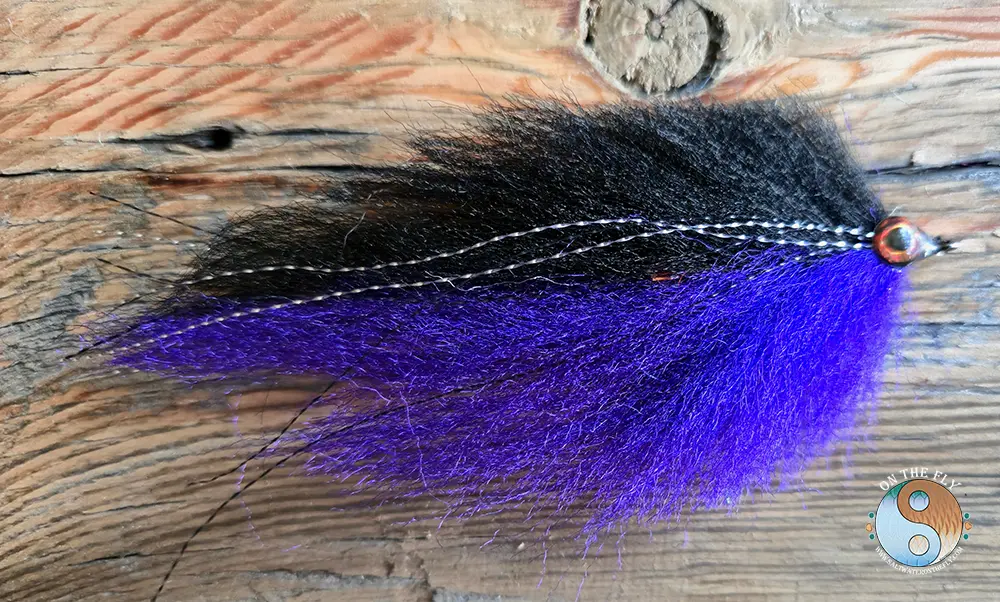
Flies Big, flashy, and built to trigger a reaction. Think large baitfish patterns, EP-style bunker imitations, big Deceiver variations, and anything that pushes water and looks like an easy meal that isn’t paying attention. Color matters less than profile and movement. White, chartreuse, and natural baitfish tones all produce. Hook size should match the species — you’re not undersizing a hook on a 200-pound bull shark and calling it a plan. Strip it fast. Keep tension. Stay ready for the kind of eat that makes your reel scream loud enough to concern bystanders.
What to Wear Sun protection is not a joke on a shark flat. You’re exposed, there’s no shade, and the water reflects everything back at you. Long sleeves, UPF protection, and a solid hood are the difference between fishing all day and tapping out at noon looking like a boiled lobster. More on that at the bottom of this post.
Where to Go: Shark Fly Fishing Locations Around the American Coast
The good news is you don’t have to travel far to find sharks worth chasing on a fly. The bad news is that means you have no excuses. Here’s a coast-by-coast breakdown of where to point the truck.
Gulf Coast
Florida Keys, FL The Keys are ground zero. Year-round action, clear water that makes sight fishing possible, and a buffet of species — lemon sharks, blacktips, bonnetheads, nurse sharks, and the occasional bull shark looking to ruin your afternoon. Winter pushes migratory blacktips south in huge numbers. If you’re going to start somewhere, start here.
Miami / Biscayne Bay, FL Shore-accessible with blacktips, nurse sharks, and bulls working the flats and nearshore structure. The water clarity is good, the fishery is accessible, and you can be back to South Beach by lunch feeling completely undeserved about it.
Tampa Bay / Sarasota, FL Bull sharks, bonnetheads, and spinners spread across one of Florida’s most productive inshore systems. Fish the grass flats, mangrove edges, and bay mouths — particularly productive in warmer months when the bait is thick.
Destin / Pensacola, FL The Gulf’s “100-fathom curve” sits just 12 miles offshore, which means you can target bigger pelagic species — blacktips, spinners, and bulls — without a full offshore commitment. Productive from late spring through fall.
South Padre Island / Galveston, TX Texas isn’t messing around. Roughly 40 species of sharks cruise the Texas Gulf Coast, with blacktips, bulls, bonnetheads, Atlantic sharpnose, and spinner sharks all in the mix. A Yucatan current sweeps bait into the coast around South Padre, which means predators follow. Galveston’s year-round fishery makes it one of the most consistently productive spots on the Gulf.
Orange Beach / Gulf Shores, AL A sleeper pick. Warm months bring blacktips, bulls, and hammerheads in solid numbers. The flats and nearshore structure hold fish from late spring through early fall, and it’s significantly less crowded than the Florida alternatives.
Atlantic Coast
Treasure Coast, FL (Stuart to Vero Beach) The annual blacktip migration through this stretch is legitimately staggering — thousands of sharks following bait southward in winter months. If you’ve never seen it, it looks like something out of a nature documentary that you’d call fake. It’s not fake. Go.
Outer Banks, NC Sitting in a prime marine migration corridor, the OBX sees northbound and southbound sharks moving through consistently year-round. Tiger sharks, blacktips, and hammerheads all show up. The shallow water makes casting challenging, which is why fly fishing here is both difficult and completely worth it. Peak season runs May through September.
Cape Hatteras, NC Considered by many to be one of the best shark fisheries on the entire Atlantic coast. The convergence of the Labrador Current and the Gulf Stream creates a marine superhighway right off the point. Bulls, tigers, blacktips, and the occasional thresher. Come prepared for wind, because it’s always windy at Hatteras.
New Jersey (Cape May to Sandy Hook) The season is short — June through August — but the summer action when warm Atlantic water pushes north is exceptional. Makos in particular show up in numbers, and a mako on a fly rod is a religious experience. Not a long window, but a productive one if you time it right.
Montauk, NY World-famous for stripers and blues, but the shark fishing is criminally underrated. Makos, blues, and threshers work the offshore structure during summer months. The guides here have forgotten more about this fishery than most people will ever know.
Cape Cod, MA If great whites are on your bucket list, this is the only address that matters. July through September brings them inshore following the grey seal population. Fly fishing for great whites is a very short list of humans who’ve done it intentionally. You could be one of them. We’re not saying you should. We’re just noting the option exists.
Pacific Coast
San Diego / Southern California Mako sharks and thresher sharks are the headline acts, and both will put on an aerial show that makes you question every fish you’ve ever caught before. Leopard sharks in the shallows are a more approachable target — sight fishing in clear water, classic flats-style hunting. San Diego’s weather and water temperature make this a standout year-round fishery on the West Coast.
Northern California / San Francisco Bay Area Leopard sharks concentrate in the Bay in warmer months in numbers that have to be seen to be believed. Accessible, visual, and surprisingly technical — these fish can be selective on the flat and reward a good presentation. Seven-gill sharks also work the Bay, and they are considerably more serious about the whole encounter.
Reason Conservation Matters More Than Your Hero Shot
Here’s where the sarcasm takes a back seat for a minute.
Sharks aren’t the villains. They’re the janitors — keeping ecosystems balanced, fish populations in check, and the ocean from turning into an overpopulated mess. Global shark populations have dropped dramatically due to overfishing, finning, and bycatch. When you’re targeting them on the fly, catch-and-release isn’t just a courtesy — it’s the whole point.
Keep them in the water as much as possible. Minimize fight time. Use circle hooks or barbless when regulations allow. No gill grabs, no dragging them up on the beach for a thirty-minute photo session. A quick, clean release means that shark is still out there, doing its job, and giving the next angler the same four seconds of stopped time that you just had.
Support shark sanctuaries. Know your local regulations. And maybe skip the fin soup trend — it’s not as sophisticated as it sounds, and the ocean doesn’t have a backup plan.
The Bottom Line
Shark fly fishing is absurd, expensive, occasionally terrifying, and completely worth it. It’s the kind of fishing that makes every other kind of fishing feel like a warm-up. You’ll probably mess up your first few shots. You’ll definitely question your decision-making at least once. You might spook more sharks than you hook.
Do it anyway.
Just make sure you’re dressed for the occasion.
Speaking of Which…
If you’re going to chase apex predators, you might as well look the part. The Shark Graphic Hoodie from Saltwater on the Fly is built for days exactly like this — UPF 50+ protection, 4-way stretch, quick-dry performance, and a shark graphic shot by underwater photographer Christian Vizl off the coast of Mexico. Not clipart. The real deal.
$78.88 → Shop the Shark Graphic Hoodie
Capt. Grumpy – Saltwater on the Fly — Gear, Content, and Bad Decisions Made in Beautiful Places.