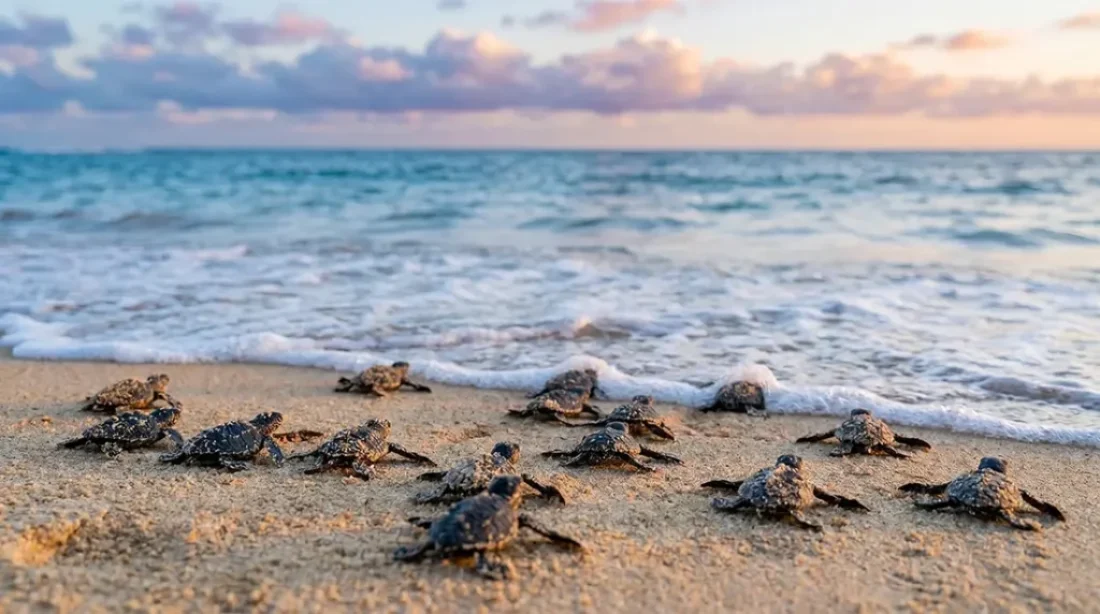
Sea Turtles: 100 Million Years in the Water and We Nearly Blew It in 50
Let’s put this in perspective.
Sea turtles have been on this planet for over 100 million years. They survived the asteroid that wiped out the dinosaurs. They outlasted ice ages, shifting continents, and mass extinctions that reshaped life on Earth entirely. They are, by any reasonable measure, one of the most successful survival stories in the history of the animal kingdom.
Then humans showed up with longlines, plastic bags, and beachfront development, and in roughly half a century we managed to drive most of the world’s seven sea turtle species to the edge of extinction.
The good news — and there is genuine good news here — is that the story doesn’t end there.
Table of Contents
The Comeback Nobody Expected
In October 2025, the International Union for Conservation of Nature made an announcement that stopped the marine conservation world in its tracks: green sea turtles, long listed as Endangered on the IUCN Red List of Threatened Species, were officially reclassified as Least Concern.
That’s not a minor adjustment. That’s one of the most significant conservation status improvements ever recorded for a long-lived marine species. The global green turtle population has increased by more than 28% since the 1970s, with nesting population recoveries documented across Mexico, Hawaii, Brazil, and other critical coastal regions worldwide.
Decades of sustained, science-based conservation — beach protection programs, legal protections for nesting females and eggs, community-based initiatives, and reduced unsustainable harvest — actually worked. In a world where environmental news tends to travel in one direction, this is worth stopping to acknowledge.
Conservation works. When people commit to it, when policy supports it, and when communities take ownership of it — it works.
That said, this is not a victory lap. It’s a halftime score.
The Seven Species and Where They Stand
There are seven species of sea turtles on Earth. Each one plays a specific, irreplaceable role in marine ecosystems. Here’s where they stand:
Green Sea Turtle — The comeback kid. Reclassified to Least Concern in 2025 after decades of recovery efforts. Some regional subpopulations in Costa Rica and Hawaii remain threatened and require continued protection.
Loggerhead Sea Turtle — Listed as Vulnerable globally. A critical species for maintaining healthy seagrass beds and coral reef ecosystems. Most Atlantic populations are considered Low Risk, while Pacific populations face significantly higher pressure.
Leatherback Sea Turtle — The largest sea turtle and the most widely ranging, crossing entire ocean basins on migration routes that would humble a frequent flier. Also the most imperiled. Leatherbacks carry the highest combined risk and threat scores of all sea turtle populations worldwide, and Pacific leatherback populations in particular are in serious trouble.
Hawksbill Sea Turtle — Critically Endangered. Their distinctive patterned shells made them a target for the tortoiseshell trade for centuries, contributing to a population decline of roughly 90% over the last hundred years. They are essential reef health indicators — hawksbills eat sponges that would otherwise suffocate coral.
Kemp’s Ridley Sea Turtle — The rarest sea turtle in the world. Critically Endangered. Their entire nesting population essentially collapsed to around 700 nesting females in the 1980s before conservation efforts pulled them back from the absolute edge.
Olive Ridley Sea Turtle — The most abundant species, but still Vulnerable. Known for mass synchronized nesting events called arribadas — thousands of females coming ashore simultaneously — they remain heavily targeted for eggs in some regions.
Flatback Sea Turtle — Found only in Australian waters. Listed as Data Deficient, which means we don’t have enough population data to properly assess where they stand. That alone should give us pause.
What’s Still Threatening Them
The recovery of green turtles is real and meaningful. But the threats that got us here haven’t gone away — they’ve mostly gotten worse.
Fisheries Bycatch This is the single largest threat to sea turtles worldwide, and it remains dramatically underreported. Sea turtles are air-breathing reptiles. When they get entangled in longlines, gill nets, trawls, or abandoned ghost gear and can’t surface, they drown. The scale of the problem across global commercial fishing operations is staggering, and solutions — turtle excluder devices, modified gear, illuminated nets — exist but aren’t universally adopted or enforced.
For anglers: use circle hooks when fishing near turtle habitat, cut lines as close to the hook as possible if a turtle is accidentally hooked, and report injured sea turtles to local wildlife authorities. These small choices matter more than most people realize.
Plastic Pollution At least 11 million metric tons of plastic enter the ocean every single year. Sea turtles eat it. They get tangled in it. Hatchlings have to navigate through it on their way from the nest to the water’s edge. Researchers estimate that more than half of all sea turtles worldwide have ingested plastic at some point — in some populations, that number exceeds 90%. A plastic bag drifting in the current looks exactly like a jellyfish to a leatherback. It is not a jellyfish.
Climate Change This one is layered and getting worse. Rising sand temperatures on nesting beaches affect hatchling sex ratios — warmer sand produces more females, and the projected long-term feminization of some populations is a genuine survival threat. Sea level rise erodes nesting beaches. Warming oceans bleach and damage coral reefs that hawksbills and loggerheads depend on for food. Climate change is not a future problem for sea turtles — it’s a present one.
Coastal Development Beachfront development, artificial lighting, seawalls, and increased boat traffic compress and fragment nesting habitat. Hatchlings use natural light gradients to navigate from nest to ocean. Artificial lighting from hotels, condos, and roads disorients them, sending them inland instead of seaward. Boat strikes are a documented, significant cause of sea turtle mortality in high-traffic coastal areas.
Direct Take Despite international trade bans and legal protections in most countries, sea turtles and their eggs are still poached for food, traditional medicine, and the illegal wildlife trade. Hawksbill shells still appear in black markets. Turtle eggs are still consumed in parts of Central America and Asia. Enforcement is inconsistent and the problem persists.
What You Can Actually Do
Conservation isn’t just a job for scientists and government agencies. The people who spend the most time on and near the water — anglers, divers, surfers, coastal campers — are on the front lines whether they think of themselves that way or not.
On the water: Use circle hooks. Reduce lead weights (sea turtles mistake sinkers for food). If you see an entangled or injured turtle, call the NOAA Sea Turtle Rescue Hotline at 1-877-WHALE-HELP. Don’t attempt to remove hooks from deeply hooked turtles yourself — trained responders can do it safely; well-intentioned removal can cause more damage.
On the beach: Keep beaches dark during nesting season. If you’re camping near nesting habitat, use red lights rather than white — sea turtles are less sensitive to red wavelengths. Don’t approach nesting females or disturb nests. Fill in holes dug on the beach before you leave — they’re hatchling traps.
At home: Reduce single-use plastic. Pick up fishing line, plastic bags, and debris when you see it on the water or beach. It is not someone else’s problem.
With your wallet: Support organizations doing real on-the-ground sea turtle conservation work — the Sea Turtle Conservancy, Oceanic Society, and the State of the World’s Sea Turtles (SWOT) project are among the most credible and effective. Buy sustainable seafood certified by programs with meaningful bycatch standards.
Why This Matters Beyond the Turtle
Sea turtles aren’t just charismatic animals worth protecting because they’re beautiful, though they are. They’re ecosystem engineers.
Green turtles graze seagrass beds, keeping them healthy and productive — seagrass beds that serve as nursery habitat for countless commercial fish species. Loggerheads crush hard-shelled prey that would otherwise overpopulate reef systems. Leatherbacks consume jellyfish in volumes that help keep jellyfish populations from destabilizing entire ocean food webs. Hawksbills control sponge growth on coral reefs.
Remove the turtles, and you don’t just lose the turtles. You lose the functions they perform, and the systems that depend on those functions start to unravel.
The ocean is not a background. It’s a system. And sea turtles have been a working part of that system for 100 million years.
Let’s not be the generation that ends that.
A Place Worth Going: The Georgia Sea Turtle Center on Jekyll Island
If you want to see what real sea turtle conservation looks like up close — not on a nature documentary, not on a donation page, but in person — Jekyll Island, Georgia is worth the drive.
Established in 2007 and operated by the Jekyll Island Authority, the Georgia Sea Turtle Center was built as an institution devoted to the rehabilitation of injured sea turtles and preservation of the coastal ecosystem. It’s also Georgia’s only facility of its kind — a functioning hospital for sick and injured sea turtles that also features an interactive exhibit gallery, rehabilitation pavilion, daily educational programs, guided tours, and beach walks. The building itself is housed in the former Jekyll Island Power Plant, a contributing structure within the Jekyll Island National Landmark Historic District.
What makes it worth your time isn’t the gift shop or the signage. It’s the transparency. Through viewing windows in the rehabilitation area, guests can see the medical pools where turtles recover and learn each patient’s story — information boards introduce the turtles by name and explain why they are being treated. You’re not looking at a display. You’re looking at a patient in actual recovery.
I did the behind-the-scenes tour with a vet tech, and I’ll be straight with you — the hatchlings and the rehab work were the highlights of the entire visit. I’ve spent time on the board of directors at the Montana Raptor Conservation Center, so I walk into wildlife rehabilitation facilities with a certain set of expectations. The Georgia Sea Turtle Center cleared every one of them. The level of care, the knowledge of the staff, and the genuine commitment to getting these animals back into the ocean is the real deal. This isn’t a tourist attraction that happens to have turtles. It’s a functioning hospital that happens to let you watch. There’s a difference, and you feel it the moment you walk in.
Since 2007, the center has treated hundreds of sick and injured turtles, with most of the animals returning home to the ocean. They also conduct active research on Georgia’s barrier islands, run nest monitoring programs, and track diamondback terrapin crossings — a species found only in the brackish marsh habitat of the Georgia coast.
If the timing works out, ask about turtle release events. Marine biologists at the Center periodically schedule turtle releases back into the ocean — these events are a significant draw and the kind of thing that sticks with you long after you’ve left the island.
It’s open daily from 9am to 5pm. The behind-the-scenes tour is worth the extra ticket. And if you’re fishing the Georgia coast or passing through the Golden Isles, there is genuinely no excuse not to stop.
Georgia Sea Turtle Center 214 Stable Road, Jekyll Island, GA 31527 (912) 635-4444 www.jekyllisland.com/activities/georgia-sea-turtle-center
One Small Way to Show Up for the Ocean
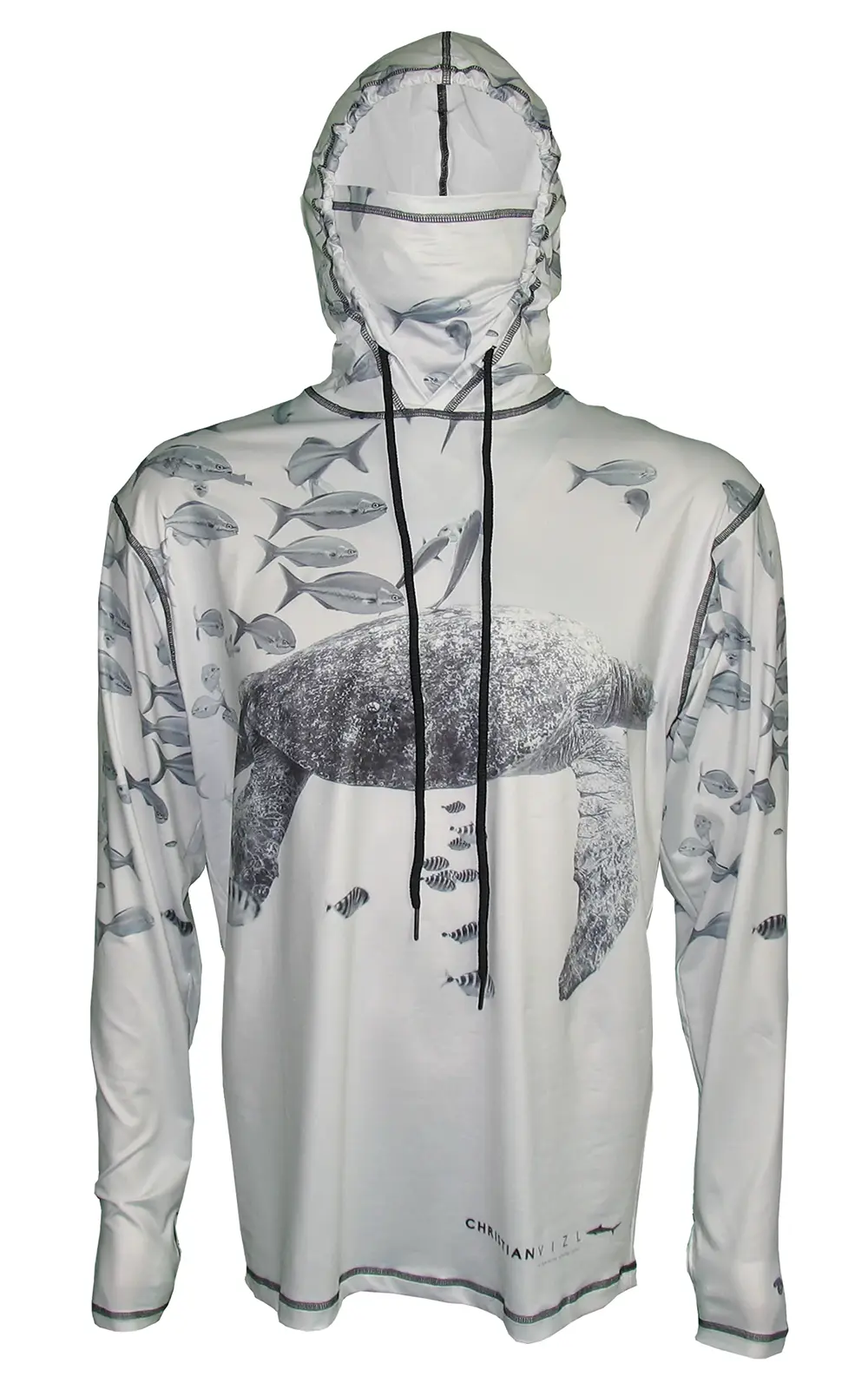
If you spend time on the water, you already know that the connection between what you wear and what you care about runs deeper than aesthetics. The Sea Turtle Graphic Hoodie from Saltwater on the Fly features underwater photography by Christian Vizl — a real sea turtle in real ocean, not clip art, not a logo. UPF 50+ protection, 4-way stretch, and built for the people who take their time outside seriously.
$79.99 → Shop the Sea Turtle Graphic Hoodie
Capt. Grumpy – Saltwater on the Fly — Gear, Content, and Bad Decisions Made in Beautiful Places.